-01.svg)

Longbow is different because it's the world’s first Featherweight Electric Vehicle manufacturer, or FEV for short. The debut model, due in 2026, is called the Speedster and is set to tip the scales at a mere 895kg. It also looks rather fetching, calling to mind the Ferrari SP2 Monza.
Despite the forward-leaning nature of Longbow, the company cites the Jaguar E-Type and Lotus Elise as spiritual inspirations. The Speedster’s construction will be a mixture of a bonded aluminium chassis and sustainably sourced composites for the body panels. This ensures simplicity – thus lightness – and also keeps the car relatively affordable.
Longbow is claiming 0–60mph in 3.5 seconds and a WLTP range of 275 miles, although the company is remaining tight-lipped about the battery size and chemistry at this early stage. In tried-and-tested British sports car fashion, Longbow will outsource the electric motor and battery to keep costs down, although the firm will write its own proprietary software. According to Top Gear, the car will be powered by a single 322bhp motor. That means a power-to-weight ratio of 360bhp/tonne.
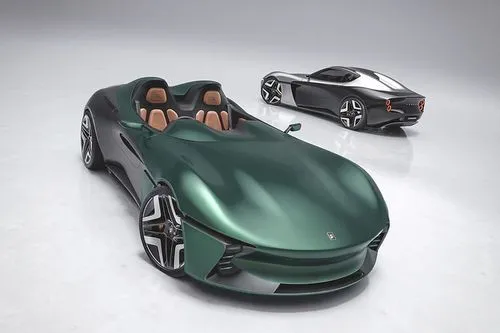
The new manufacturer is the vision of British engineers Daniel Davy and Mark Tapscott. Both have held senior positions at Tesla, Lucid, Polestar and BYD. Davy will act as the company’s CEO, whilst Tapscott is the COO. Another founding partner is Jenny Keisu, a finance expert and CEO of X Shore, the electric powerboat manufacturer.
Tapscott spent his formative years at Lotus, developing Lotus Elise and GT race cars, often competing himself. It tells: Longbow’s guiding philosophy of ‘simplify, focus on beauty and engagement, then relentlessly add lightness’ – is a clear riff on Norfolk’s. The company motto is also celeritas levitatis – Latin for moving at the speed of lightness.
Davy passionately delivers a rallying call against motoring obesity: “Amidst the e-mobility revolution, we have lost something important. Many modern ‘sports cars’ tip the scales at 1,500kg, and BEVs can reach almost double that. There is a need for a more driver-oriented, featherweight electric sports car – one that is attainable and accessible, for those who love driving and the places it takes them. That is why we have created Longbow. Our first two cars embody everything a modern driver’s car should be: agile, balanced, electric and exhilarating.”
The starting price for the Speedster will be £84,995, and production will be limited to 150 units. The first ten will be an ultra-exclusive Luminary 1st Edition, and each one will be “fully loaded” and built to the customer’s specifications. The price of such exclusivity is significant – £119,995. Following on from the Luminary 1st Edition will be the Autograph Edition, of which 25 will be built.
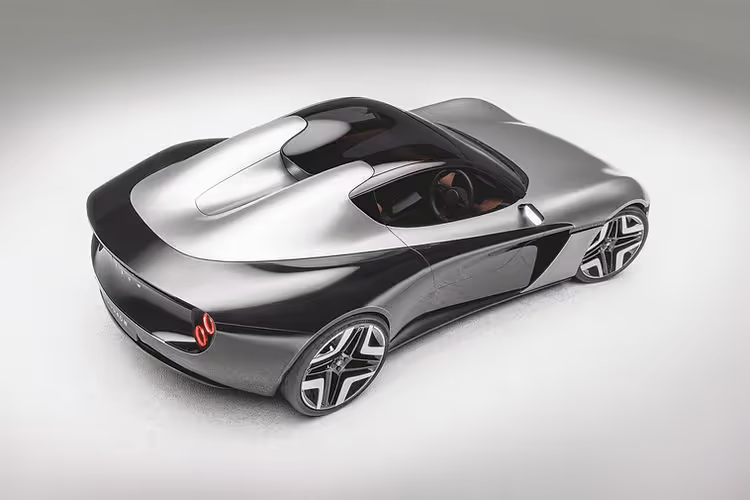

Only once the 150 build slots have been satisfied will the second car in these images, the confusingly named Roadster, go into production. No, your eyes do not deceive you – it is indeed a coupé and not a folding hardtop or targa. The name is a direct jibe at Elon Musk and the eternally delayed Tesla Roadster MkII.
The Roadster version will weigh 100kg more at 995kg and complete the benchmark sprint in 3.6 seconds. The good news is the target price of the Roadster – £64,995. Again, 150 will be built, although this time around, 50 will be 1st Editions.
All will be hand-built in England and feature an interior inspired by craftsmanship, with machined surfaces and knurled dials. This doesn’t mean the Longbow will be low-tech, as the car will be able to blend the driver’s bio-data with built-in telematics software, further connecting man and machine and creating what Longbow claims are “Auto-Sapiens”.
Whilst Longbow is set to be the first electric British sports car manufacturer, by 2026 it won’t have the market all to itself. The BEV successor to the Alpine A110 is also due, as is the Caterham Project V, while this year will see the launch of the controversial electric Porsche Boxster. Lotus will also doubtless have an electric replacement for the Emira in development. Then there is the MG Cyberster, although at 1,885kg it shouldn’t be considered a direct rival.
Longbow has chosen to wade into battle with Boudica as its emblem, an ancient British queen who led a revolt against the Roman Empire. Although her uprising ultimately failed, this upstart car manufacturer might just have the ingredients to make its rebellion a lasting one.



.svg)

