NEWS, SHORT SHIFT
Alpina Officially Becomes Part of BMW
Ken Pearson
By
Images by
Alpina + BMW
Published
6 Jan 2026
Alpina Officially Becomes Part of BMW

What does the future hold for Alpina now the brand has been absorbed into the BMW Group? Ken Pearson looks ahead, and Craig Toone looks back at the best Alpinas to date.
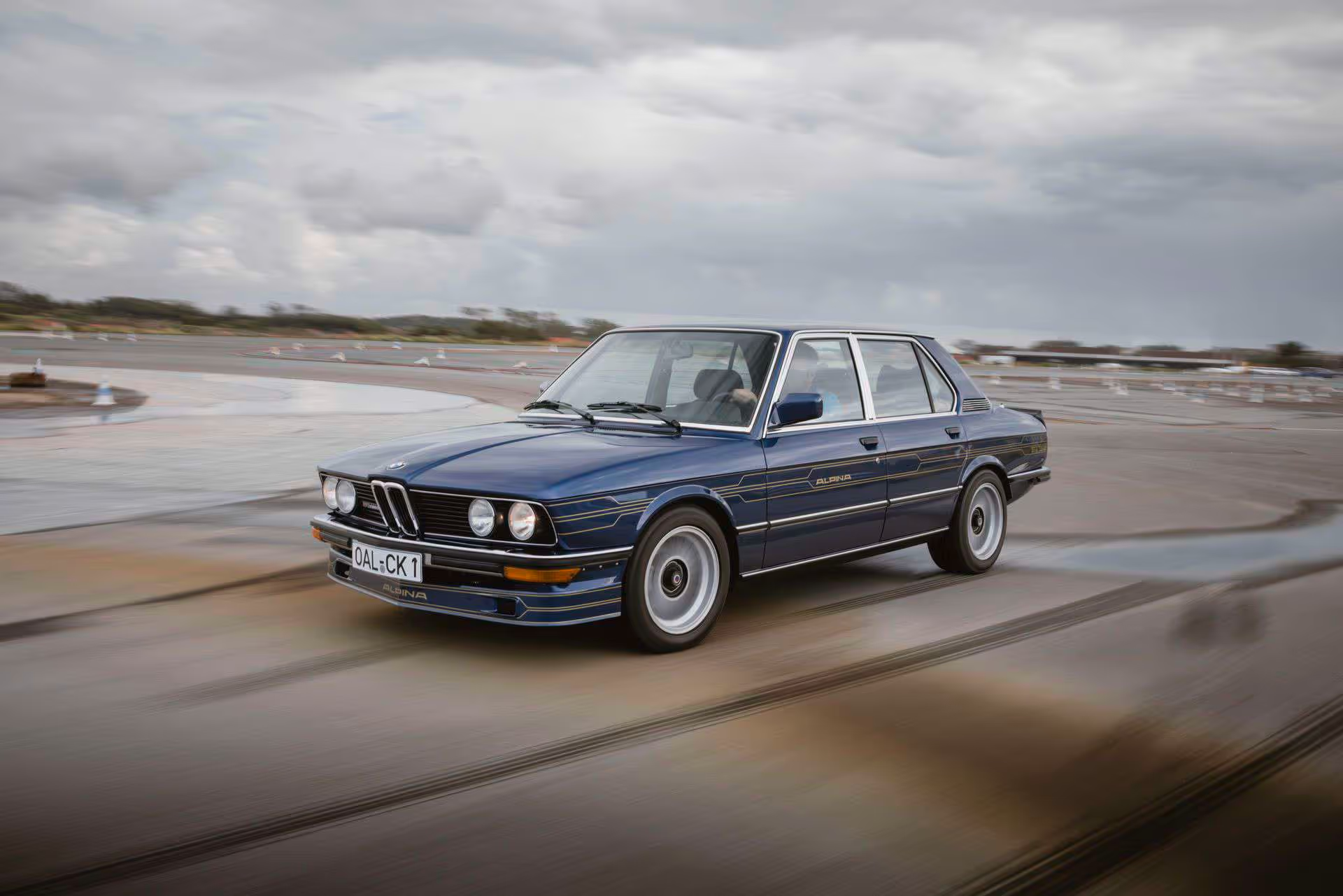
Following 60 years of independently crafting high-performance BMWs, the rights to the Alpina name and brand have transferred from Buchloe to Munich. Despite being a relatively small player, the brand has built a cult following and a strong reputation for elevating Munich’s finest. The distinctive pinstripes and signature wheels carry certain expectations.
The brand had posted record sales, but the financial success became a double-edged sword; seen by the German government as a manufacturer rather than a tuning house, Alpina sold too many cars to be considered a niche car builder. This meant that it was unable to perpetually avoid the fleet emissions rules that ultra-low-volume carmakers such as Pagani and Morgan are exempt from.
This, alongside tightening safety regulations and the advancement of electrification, led to the Bovensiepen family’s decision to sell the famous brand to BMW. While electric cars are certainly on the cards now, Alpina’s new owners aren’t about to reinvent the turbine-spoke wheel. While there had been fears that the combination of performance, comfort and exclusivity would be lost as it joined the mothership, BMW has confirmed that Alpina will be a standalone marque within the group, stating that respecting its history and ethos are a “tremendous responsibility”.


As such, a move to weaponise its new intellectual property and flood the model range with Alpina-Line models would be highly unlikely. Given the transfer of ownership was marked with a gently worded press release rather than a slew of outlandish concept cars or accessories packages, it appears BMW is being wise enough to resist such low-hanging fruit.
There will be changes though, with extensive personalisation options already being touted as a key pillar of the future product offering. As for the cars themselves, it’s safe to expect future models to evolve the present design strategy of a distinct yet understated look to enhance the style of the cars on which they’re based. This is due to the design work coming in house, with former Polestar chief designer Maximilian Missoni tasked with shaping the next era of Alpinas.
As such, there will be greater scope for visual separation between BMW, M and Alpina models beyond the unique wheels, splitters and exhausts that we’ve become accustomed to. BMW have confirmed that the freshly updated wordmark will feature “at the centre of the rear” of future models, but beyond an expected mixture of petrol and electric powertrains, what form those cars take remains to be seen.


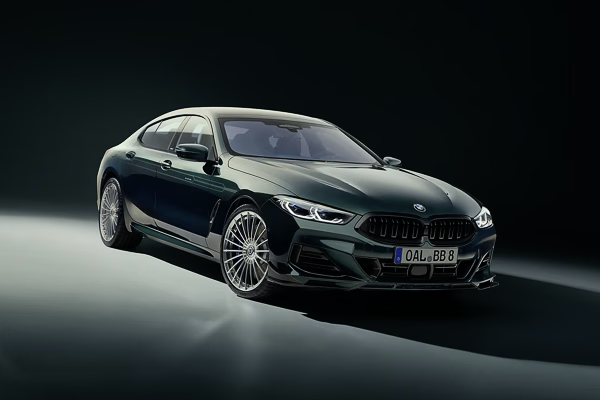
That said, the Alpina brand is in a prime position to go upmarket, with a gap in terms of price and exclusivity between BMW and Rolls-Royce. Keeping the focus on performance as much as refinement, it’d be natural for Alpina to be elevated to target Bentley, and Jaguar upon the arrival of the production-ready Type 00. Thus, the 7 Series and i7 – which are due for a facelift in 2026 – would be natural starting points, and the first new BMW Alpina could be unveiled by the end of this year. The ever-popular large SUV class would be a logical next step. With the incoming second-generation X7, a rival for the Bentley Bentayga, and Mercedes-Maybach's GLS and EQS SUVs could easily be crafted.
Given the success of BMW’s Skytop and Speedtop special models, ultra-low-volume halo cars could also be seen in the coming years. Such an upwards pivot does cast doubts over the smaller models in the range initially, but they shouldn’t be ruled out in the long term. The 5 Series is due for a facelift in 2027, and while an Alpina variant of the G60/61 would be a new proposition, it would bring a much-loved model back to the executive segment. Likewise, the ever-popular 3 Series-based models have coexisted alongside the M3 for decades, admittedly with different customer bases, but similar budgets – as the six-figure B3 and B4 GT proved most recently.
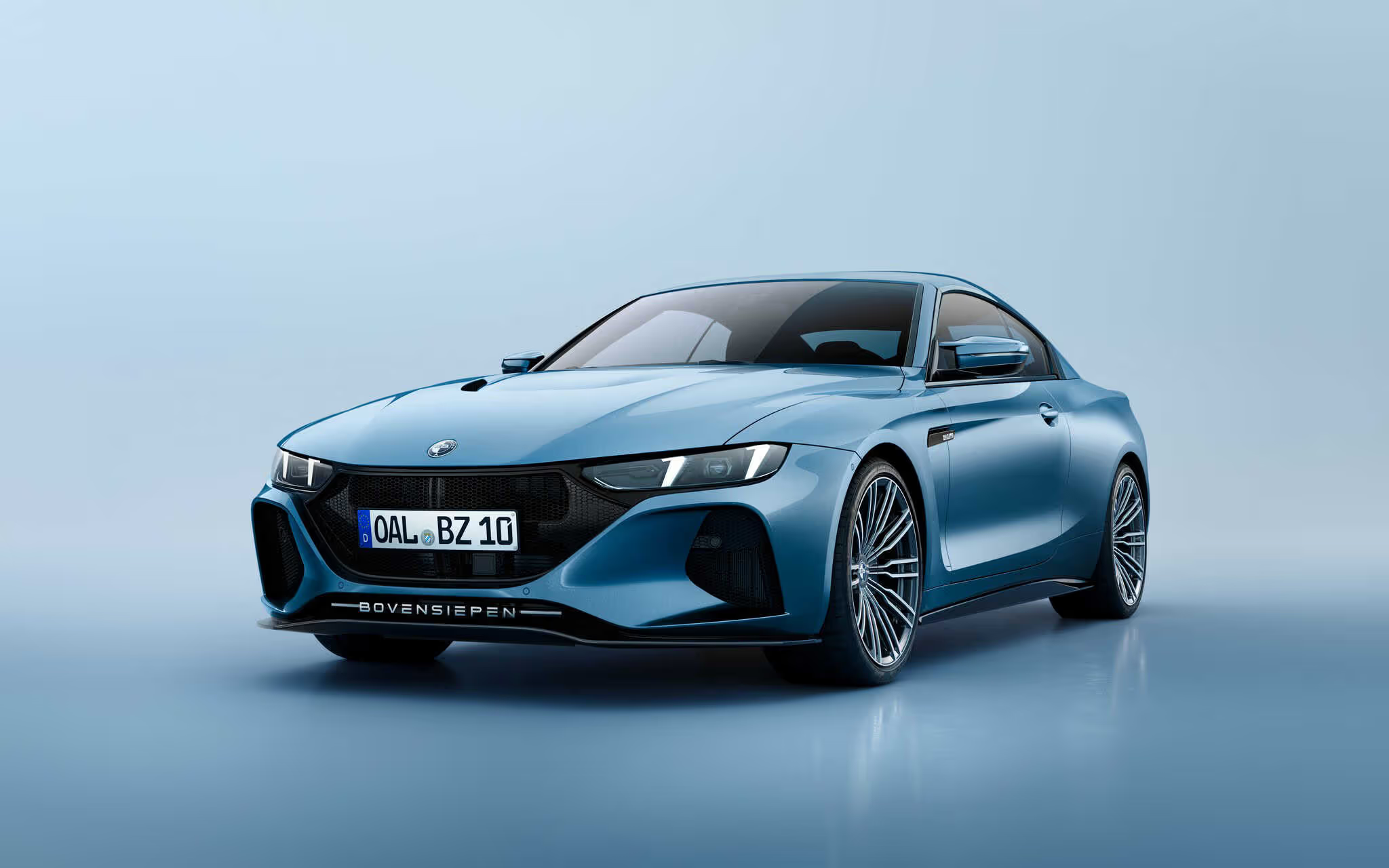
It’s important to note that while the brand has changed hands, the company behind the last 60 years of expertly tuned BMWs has not. Now known as Alpina Classic, the family-owned business will look after the brand’s heritage, and models made from 1965–2025. Design, engineering and material crafting continues in Buchloe, with the latest results being seen on a new coachbuilt coupé: the Bovensiepen Zagato – an Alpina in all but name.


Alpina has also been working as an engineering consultant to BMW for the past 12 years, with over 30 dedicated engineers refining suspension, stability control systems and powertrains. This relationship will remain in place and operate out of Buchloe, according to Werke magazine's recent interview with Andreas Bovensiepen in issue 06.
The finer details are subject to speculation for now, but the direction of travel will be confirmed as 2026 goes on. As part of the brand-building effort, we expect the number of retailers selling new Alpina models to increase significantly in the next few years. Taking the marque from being an open secret to recognised as a key part of BMW will be as much of a task as designing new models; those of us reading this know what the name means, but to many in the luxury market it’ll be an entirely new proposition.
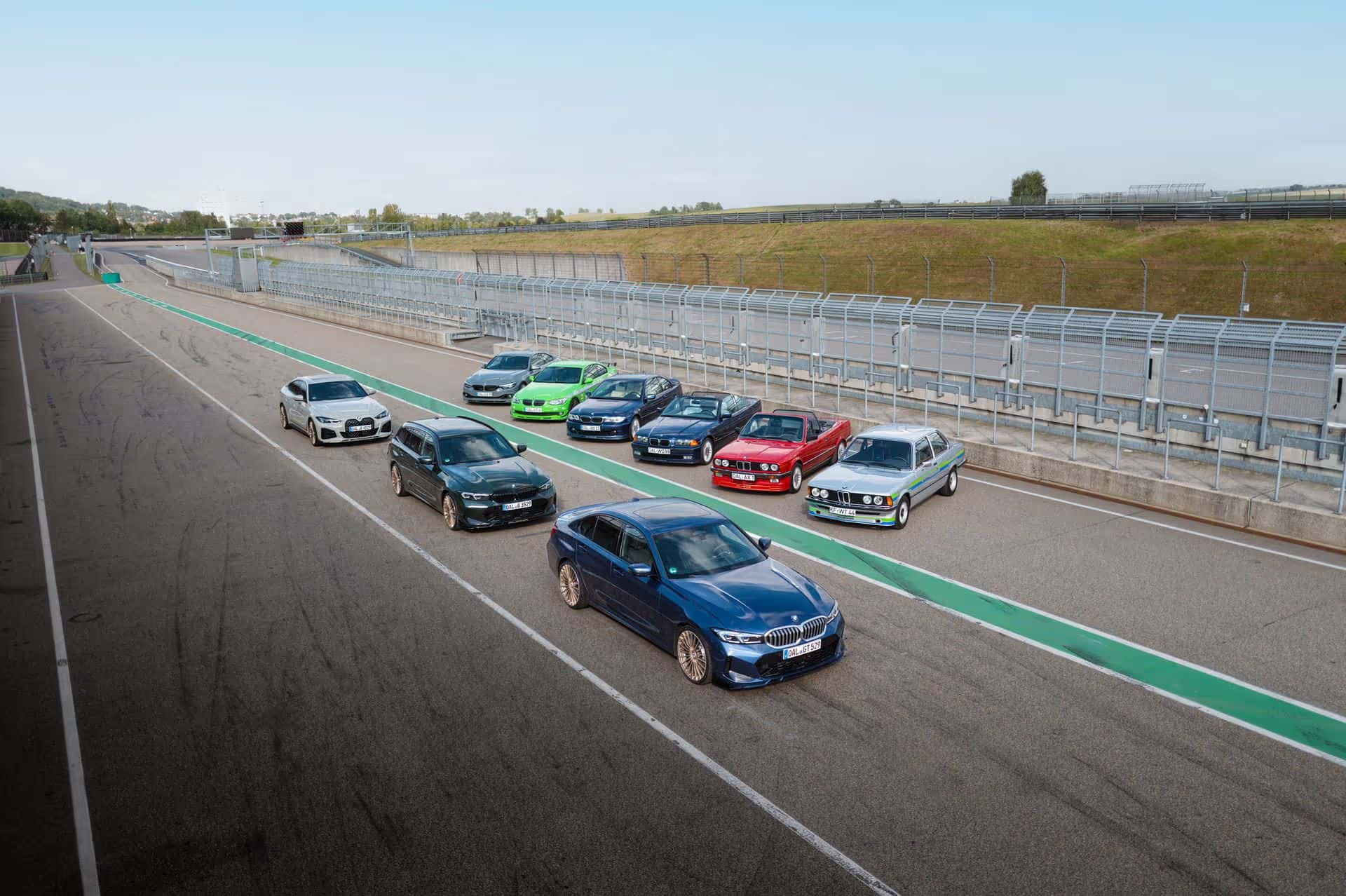
Alpina’s Greatest Hits
Craig Toone looks back at Alpina’s legacy as an independent manufacturer, highlighting the stand-out models from the last six decades.
2002tii A4S
It's hard to imagine it now, but the Alpina name originally adorned machines with 45 keys aimed at typing 11s onto paper with ink, rather than onto the road with rubber.
The son of the company founders – Burkard Bovensiepen – was, however, a tinkerer. After completing his mechanical engineering degree, he began modifying carburettors and cylinder heads in his spare time and started to garner a following for making a BMW 1600 as fast as the 2002. Acknowledging this burgeoning talent and seeing the writing on the wall with the advent of the electric typewriter, the Bovensiepens switched their focus to tuning cars in 1965, operating out of a small workshop in Kaufbeuren.
By 1970, Alpina had gained factory warranty approval from BMW and was running its racing team, employing over 70 people. In that year, 2002-based racers won the European Touring Car Championship, the German Hillclimb Championship, and the prestigious Spa 24 Hours.

The road-going A4S capitalised on this success, with the 2002 being the car of the moment and Alpina the go-to tuner for it. Taking BMW's fuel-injected 2002tii as a base (130bhp), Alpina's modified cylinder head, forged pistons and tubular exhaust manifold upped the ante to 169bhp at 7,000rpm. This matched the headline output of BMW's own 2002 Turbo but without the lag, and offered better fuel economy, for 1,500DM less.
Alpina also sold a five-speed gearbox to make better sense of the peaky delivery, with 133lb-ft of torque delivered at 5,000rpm. To ensure the 2002 could cope with this newfound power, Alpina manufactured its own semi-trailing rear arms, thicker anti-roll bars and ventilated front brake discs.
The performance of the A4S remains impressive today. Depending on gearing, the A4S could achieve 130mph, and thanks to its svelte 1,000kg kerb weight, 0–62mph was boxed off in 7.4 seconds – enough to give many hot hatches something to think about at the traffic lights.
E12 B7 S Turbo and E24 Turbo Coupé

The 1970s was a more turbulent time not just for Alpina (with the establishment of BMW Motorsport GmbH) but, thanks to two oil crises, for the performance car itself. Alpina knew they had to evolve and strategically pivoted to luxury performance and grand touring toward the end of the decade. In 1978, they sold their first complete factory car – the B6 2.8, based on the E21 3 Series – and never looked back.
Not that a B7 S Turbo driver would ever have to look in the rear-view mirror with 330bhp at their disposal. Building on the B7 Turbo, the S added an additional 500cc to the straight-six and switched the turbocharger to a KKK K27.
While size matters, being Alpina there was more to it than that with not one, but two production car firsts in the fully digital, computer-controlled map ignition system and a Cser air intake resonance system (the first petrol application). These innovations permitted Alpina to control turbo knock and reduce lag – principles that remain fundamental to modern forced induction.
Such power was backed up with an absurd 369lb-ft (500Nm) of torque delivered at just 3,000rpm. Remember, turbocharging was in its infancy at the time, and lag was measured with a sundial, not a tachometer. BMW offered the 2002 Turbo, Saab the 99 Turbo, and of course, there was the Porsche 911 Turbo. Each one had its flaws where the Alpina offered refinement and response. An onboard boost controller even meant the driver could tailor the amount of boost between 0.6 and 0.9 bar whilst stalking prey on the autobahn.
With 1,535kg to motivate, the B7 S Turbo covered 0–62mph in 5.8 seconds, and ran on to a vmax of 163mph. Not bad for cars equipped with the beautiful but aerodynamically challenged shark-nose front end.
Following the debut of the regular B7 in 1978, only 60 B7 S Turbo saloons and 30 S Turbo Coupés were produced between November 1981 and May 1982. The production run may have been small, but the impact was seismic – marking the moment Alpina shed its tuner skin and emerged as a legitimate engineering firm. Not long after, in 1983, Alpina would be officially recognised as a manufacturer in their own right by Germany’s TÜV body.
E34 B10 BiTurbo

If the B7 S Turbo certified Alpina's credentials, the B10 BiTurbo was the megaphone moment. When it debuted at Geneva in 1989, Buchloe claimed it was the fastest production four-door in the world. And they weren't exaggerating.
Long before Lotus set its sights on the Carlton, Alpina took BMW's M30 straight-six, completely dismantled it, fitted forged Mahle pistons, then bolted on twin Garrett T25 water-cooled turbochargers. The resulting 355bhp and 384lb-ft (521Nm) was more than double the standard 535i's output. It's little surprise this sober-looking E34 5 Series with a sunroof and rear blinds rockets to 62mph in a claimed 5.6 seconds – a figure quickly proven as highly conservative when independent testers got their hands on the BiTurbo and noted it outran the Ferrari Testarossa to 124mph. It challenged the Italian on top speed too, clocking over 180mph.
Despite costing twice what BMW charged for an M5, the B10 BiTurbo went on to become the firm's best-selling model up to that point. 507 were built before BMW discontinued the M30 engine in 1993, sending the final 50 blocks to Buchloe to find homes in the B10.
E36 B8

Despite the success of the BiTurbo, the 90s saw Alpina pivoting back to naturally aspirated engines as everyone else went all-in on turbocharging. To placate a customer base used to a giant slug of easy torque, Buchloe decided the solution was to fit a V8 into the snout of BMW’s smallest model.
BMW themselves had tried and failed to fit their own V8 to the E36 during development. ‘Impossible’ was the conclusion by Dr Wolfgang Rietzle, BMW’s chief engineer. Alpina, however, had an ace up its sleeve – BMW's production lines dictated the engine must rise up to meet the chassis during the build process, but Alpina lowered the powerplant into the chassis.
That didn’t mean it was plain sailing. Over 40 modifications were made to the engine bay to accommodate the initially planned 4.0-litre BMW V8 before it was superseded by Alpina’s own 4.6-litre version, whose block was cast by the BMW foundry. Not only had Buchloe proved Rietzle wrong, it managed to rub it in the M3’s face; 333bhp and 347lb-ft (470Nm) meant 0–62mph took less than five seconds. But it was the breadth of the torque output that really distanced the B8 from the M3, eclipsing the M car’s peak of 236lb-ft from a mere 1,000rpm.
Alongside the 8 Series-based B12 5.7, the E36 range carried another Alpina first: Switchtronic – a torque converter automatic with manual gear selection that beat Porsche's Tiptronic to market by over two years. Though the B8 remained manual-only, the straight-six B3 offered this innovation as early as 1992.
F80 Alpina D3
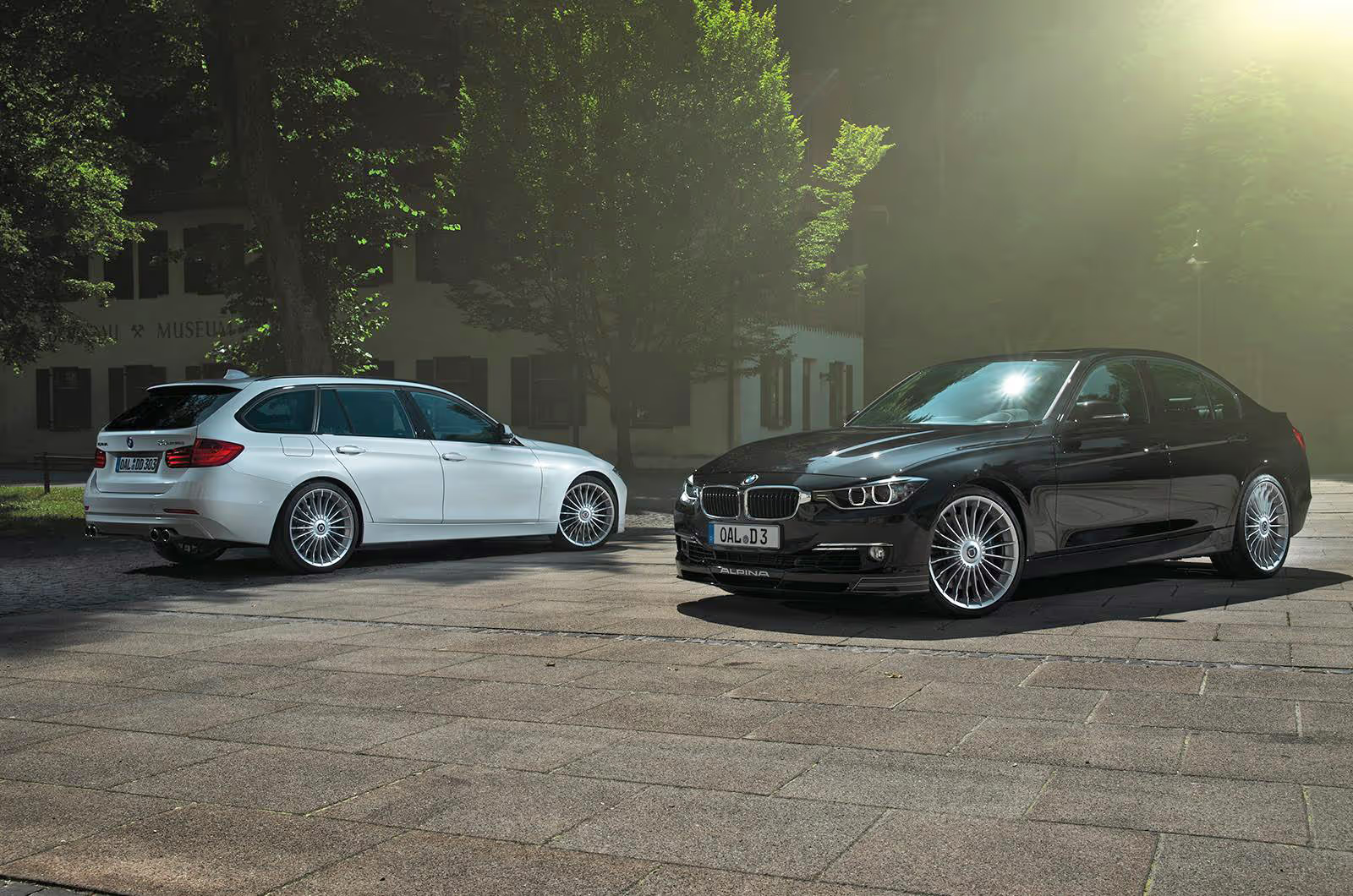
While BMW made high-performance diesels acceptable in the eyes of enthusiasts, Alpina made one that was genuinely aspirational.
Buchloe already had previous with the D10 BiTurbo of 1999, which became the most potent diesel-powered car in the world at the time of sale, offering 242bhp. This was promptly followed by the more-accessible four-cylinder E90 D3, but it was in the F80 generation where the concept found its feet. The D3 took the 335d’s already potent twin-turbocharged straight-six and turned the wick up from 305bhp to 350bhp. More importantly, torque increased from 465lb-ft (630Nm) to a mighty 516lb-ft (700Nm) – a figure that was sustained for an additional 750rpm.
Lined in Lavalina leather, the D3 can hit 62mph from rest in 4.6 seconds and go on to a top speed of 173mph – all while returning over 50mpg and cruising silently. Available in coupé, saloon and touring forms, this combination of flexibility, refinement and range makes for a compelling GT car – and proved diesel was no longer a compromise.
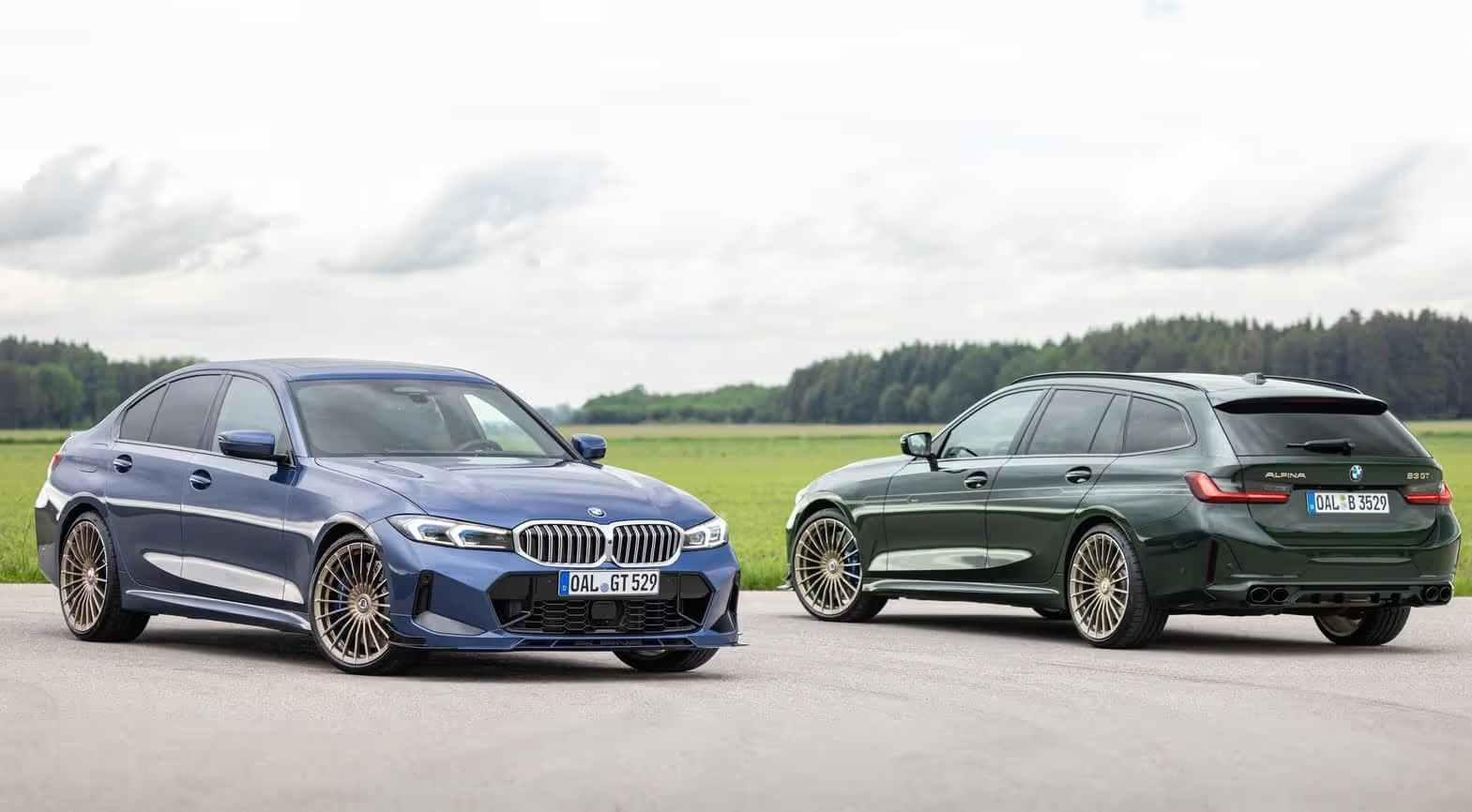
G81 B3 GT Touring

While the 205mph B8 GT holds the honour of being Alpina's final independently developed car, the B3 GT Touring will be remembered as the true swansong.
By now, Alpina had such close ties to BMW, the company had been given the keys to the M Division’s vault. The B3 had already been using the M3’s S58 engine since 2020. Naturally, Buchloe still found a way to make it their own, with bespoke turbochargers, improved cooling and unique ECU mapping pivoting the straight-six’s character. The B3 sacrificed top-end fireworks for a stronger mid-range, offering 516lb-ft (700Nm) of torque from 2,500rpm – compared to the M3’s 443lb-ft (600Nm) at the time.
For the GT, Alpina upped the ante from the standard B3's 462bhp to 522bhp, while torque swelled to 538lb-ft (730Nm) – enough to outshine the M3 CS and power it to 190mph. Beyond the additional grunt, the GT brought comprehensive upgrades. Oro Tecnico gold-finished dome-to-bulkhead struts increased rigidity, a beefed-up rear anti-roll bar and recalibrated steering sharpened turn-in, while GT-specific dampers further refined Alpina’s signature Comfort+ mode.
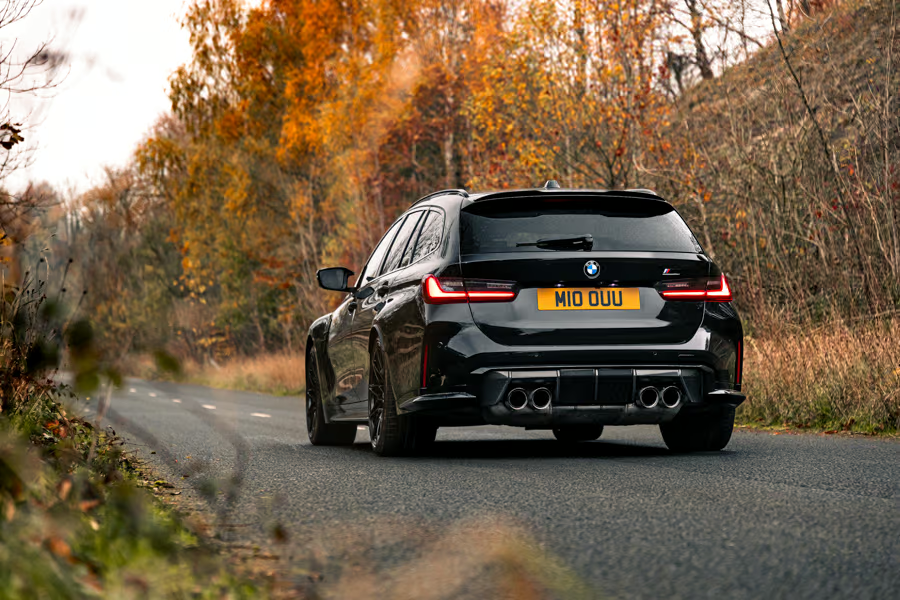
In a Touring bodyshell complete with gold pinstripes and alloys, it is perhaps the essence of Alpina – ensuring the reins are being passed at an all-time high.
Author
Photography by:
Alpina + BMW
Published on:
6 January 2026
Our Print Magazine
LATEST ARTICLES
About the Author

Ken Pearson
Deputy Editor
Resident Mercedes expert, affordable drivers' car champion and EV sympathiser. Can often be found on the other end of an argument with Craig with regards to powertrains and styling, bringing balance to the force.
Related Articles
NEVER MISS AN ARTICLE

What does the future hold for Alpina now the brand has been absorbed into the BMW Group? Ken Pearson looks ahead, and Craig Toone looks back at the best Alpinas to date.
Alpina + BMW
6 January 2026
What does the future hold for Alpina now the brand has been absorbed into the BMW Group? Ken Pearson looks ahead, and Craig Toone looks back at the best Alpinas to date.
First published
6 January 2026
Last updated
6 January 2026
Photography
Alpina + BMW
W
Following 60 years of independently crafting high-performance BMWs, the rights to the Alpina name and brand have transferred from Buchloe to Munich. Despite being a relatively small player, the brand has built a cult following and a strong reputation for elevating Munich’s finest. The distinctive pinstripes and signature wheels carry certain expectations.
The brand had posted record sales, but the financial success became a double-edged sword; seen by the German government as a manufacturer rather than a tuning house, Alpina sold too many cars to be considered a niche car builder. This meant that it was unable to perpetually avoid the fleet emissions rules that ultra-low-volume carmakers such as Pagani and Morgan are exempt from.
This, alongside tightening safety regulations and the advancement of electrification, led to the Bovensiepen family’s decision to sell the famous brand to BMW. While electric cars are certainly on the cards now, Alpina’s new owners aren’t about to reinvent the turbine-spoke wheel. While there had been fears that the combination of performance, comfort and exclusivity would be lost as it joined the mothership, BMW has confirmed that Alpina will be a standalone marque within the group, stating that respecting its history and ethos are a “tremendous responsibility”.


As such, a move to weaponise its new intellectual property and flood the model range with Alpina-Line models would be highly unlikely. Given the transfer of ownership was marked with a gently worded press release rather than a slew of outlandish concept cars or accessories packages, it appears BMW is being wise enough to resist such low-hanging fruit.
There will be changes though, with extensive personalisation options already being touted as a key pillar of the future product offering. As for the cars themselves, it’s safe to expect future models to evolve the present design strategy of a distinct yet understated look to enhance the style of the cars on which they’re based. This is due to the design work coming in house, with former Polestar chief designer Maximilian Missoni tasked with shaping the next era of Alpinas.
As such, there will be greater scope for visual separation between BMW, M and Alpina models beyond the unique wheels, splitters and exhausts that we’ve become accustomed to. BMW have confirmed that the freshly updated wordmark will feature “at the centre of the rear” of future models, but beyond an expected mixture of petrol and electric powertrains, what form those cars take remains to be seen.


That said, the Alpina brand is in a prime position to go upmarket, with a gap in terms of price and exclusivity between BMW and Rolls-Royce. Keeping the focus on performance as much as refinement, it’d be natural for Alpina to be elevated to target Bentley, and Jaguar upon the arrival of the production-ready Type 00. Thus, the 7 Series and i7 – which are due for a facelift in 2026 – would be natural starting points, and the first new BMW Alpina could be unveiled by the end of this year. The ever-popular large SUV class would be a logical next step. With the incoming second-generation X7, a rival for the Bentley Bentayga, and Mercedes-Maybach's GLS and EQS SUVs could easily be crafted.
Given the success of BMW’s Skytop and Speedtop special models, ultra-low-volume halo cars could also be seen in the coming years. Such an upwards pivot does cast doubts over the smaller models in the range initially, but they shouldn’t be ruled out in the long term. The 5 Series is due for a facelift in 2027, and while an Alpina variant of the G60/61 would be a new proposition, it would bring a much-loved model back to the executive segment. Likewise, the ever-popular 3 Series-based models have coexisted alongside the M3 for decades, admittedly with different customer bases, but similar budgets – as the six-figure B3 and B4 GT proved most recently.
It’s important to note that while the brand has changed hands, the company behind the last 60 years of expertly tuned BMWs has not. Now known as Alpina Classic, the family-owned business will look after the brand’s heritage, and models made from 1965–2025. Design, engineering and material crafting continues in Buchloe, with the latest results being seen on a new coachbuilt coupé: the Bovensiepen Zagato – an Alpina in all but name.


Alpina has also been working as an engineering consultant to BMW for the past 12 years, with over 30 dedicated engineers refining suspension, stability control systems and powertrains. This relationship will remain in place and operate out of Buchloe, according to Werke magazine's recent interview with Andreas Bovensiepen in issue 06.
The finer details are subject to speculation for now, but the direction of travel will be confirmed as 2026 goes on. As part of the brand-building effort, we expect the number of retailers selling new Alpina models to increase significantly in the next few years. Taking the marque from being an open secret to recognised as a key part of BMW will be as much of a task as designing new models; those of us reading this know what the name means, but to many in the luxury market it’ll be an entirely new proposition.
Alpina’s Greatest Hits
Craig Toone looks back at Alpina’s legacy as an independent manufacturer, highlighting the stand-out models from the last six decades.

2002tii A4S
It's hard to imagine it now, but the Alpina name originally adorned machines with 45 keys aimed at typing 11s onto paper with ink, rather than onto the road with rubber.
The son of the company founders – Burkard Bovensiepen – was, however, a tinkerer. After completing his mechanical engineering degree, he began modifying carburettors and cylinder heads in his spare time and started to garner a following for making a BMW 1600 as fast as the 2002. Acknowledging this burgeoning talent and seeing the writing on the wall with the advent of the electric typewriter, the Bovensiepens switched their focus to tuning cars in 1965, operating out of a small workshop in Kaufbeuren.
By 1970, Alpina had gained factory warranty approval from BMW and was running its racing team, employing over 70 people. In that year, 2002-based racers won the European Touring Car Championship, the German Hillclimb Championship, and the prestigious Spa 24 Hours.

The road-going A4S capitalised on this success, with the 2002 being the car of the moment and Alpina the go-to tuner for it. Taking BMW's fuel-injected 2002tii as a base (130bhp), Alpina's modified cylinder head, forged pistons and tubular exhaust manifold upped the ante to 169bhp at 7,000rpm. This matched the headline output of BMW's own 2002 Turbo but without the lag, and offered better fuel economy, for 1,500DM less.
Alpina also sold a five-speed gearbox to make better sense of the peaky delivery, with 133lb-ft of torque delivered at 5,000rpm. To ensure the 2002 could cope with this newfound power, Alpina manufactured its own semi-trailing rear arms, thicker anti-roll bars and ventilated front brake discs.
The performance of the A4S remains impressive today. Depending on gearing, the A4S could achieve 130mph, and thanks to its svelte 1,000kg kerb weight, 0–62mph was boxed off in 7.4 seconds – enough to give many hot hatches something to think about at the traffic lights.
E12 B7 S Turbo and E24 Turbo Coupé

The 1970s was a more turbulent time not just for Alpina (with the establishment of BMW Motorsport GmbH) but, thanks to two oil crises, for the performance car itself. Alpina knew they had to evolve and strategically pivoted to luxury performance and grand touring toward the end of the decade. In 1978, they sold their first complete factory car – the B6 2.8, based on the E21 3 Series – and never looked back.
Not that a B7 S Turbo driver would ever have to look in the rear-view mirror with 330bhp at their disposal. Building on the B7 Turbo, the S added an additional 500cc to the straight-six and switched the turbocharger to a KKK K27.
While size matters, being Alpina there was more to it than that with not one, but two production car firsts in the fully digital, computer-controlled map ignition system and a Cser air intake resonance system (the first petrol application). These innovations permitted Alpina to control turbo knock and reduce lag – principles that remain fundamental to modern forced induction.
Such power was backed up with an absurd 369lb-ft (500Nm) of torque delivered at just 3,000rpm. Remember, turbocharging was in its infancy at the time, and lag was measured with a sundial, not a tachometer. BMW offered the 2002 Turbo, Saab the 99 Turbo, and of course, there was the Porsche 911 Turbo. Each one had its flaws where the Alpina offered refinement and response. An onboard boost controller even meant the driver could tailor the amount of boost between 0.6 and 0.9 bar whilst stalking prey on the autobahn.
With 1,535kg to motivate, the B7 S Turbo covered 0–62mph in 5.8 seconds, and ran on to a vmax of 163mph. Not bad for cars equipped with the beautiful but aerodynamically challenged shark-nose front end.
Following the debut of the regular B7 in 1978, only 60 B7 S Turbo saloons and 30 S Turbo Coupés were produced between November 1981 and May 1982. The production run may have been small, but the impact was seismic – marking the moment Alpina shed its tuner skin and emerged as a legitimate engineering firm. Not long after, in 1983, Alpina would be officially recognised as a manufacturer in their own right by Germany’s TÜV body.
E34 B10 BiTurbo

If the B7 S Turbo certified Alpina's credentials, the B10 BiTurbo was the megaphone moment. When it debuted at Geneva in 1989, Buchloe claimed it was the fastest production four-door in the world. And they weren't exaggerating.
Long before Lotus set its sights on the Carlton, Alpina took BMW's M30 straight-six, completely dismantled it, fitted forged Mahle pistons, then bolted on twin Garrett T25 water-cooled turbochargers. The resulting 355bhp and 384lb-ft (521Nm) was more than double the standard 535i's output. It's little surprise this sober-looking E34 5 Series with a sunroof and rear blinds rockets to 62mph in a claimed 5.6 seconds – a figure quickly proven as highly conservative when independent testers got their hands on the BiTurbo and noted it outran the Ferrari Testarossa to 124mph. It challenged the Italian on top speed too, clocking over 180mph.
Despite costing twice what BMW charged for an M5, the B10 BiTurbo went on to become the firm's best-selling model up to that point. 507 were built before BMW discontinued the M30 engine in 1993, sending the final 50 blocks to Buchloe to find homes in the B10.
E36 B8

Despite the success of the BiTurbo, the 90s saw Alpina pivoting back to naturally aspirated engines as everyone else went all-in on turbocharging. To placate a customer base used to a giant slug of easy torque, Buchloe decided the solution was to fit a V8 into the snout of BMW’s smallest model.
BMW themselves had tried and failed to fit their own V8 to the E36 during development. ‘Impossible’ was the conclusion by Dr Wolfgang Rietzle, BMW’s chief engineer. Alpina, however, had an ace up its sleeve – BMW's production lines dictated the engine must rise up to meet the chassis during the build process, but Alpina lowered the powerplant into the chassis.
That didn’t mean it was plain sailing. Over 40 modifications were made to the engine bay to accommodate the initially planned 4.0-litre BMW V8 before it was superseded by Alpina’s own 4.6-litre version, whose block was cast by the BMW foundry. Not only had Buchloe proved Rietzle wrong, it managed to rub it in the M3’s face; 333bhp and 347lb-ft (470Nm) meant 0–62mph took less than five seconds. But it was the breadth of the torque output that really distanced the B8 from the M3, eclipsing the M car’s peak of 236lb-ft from a mere 1,000rpm.
Alongside the 8 Series-based B12 5.7, the E36 range carried another Alpina first: Switchtronic – a torque converter automatic with manual gear selection that beat Porsche's Tiptronic to market by over two years. Though the B8 remained manual-only, the straight-six B3 offered this innovation as early as 1992.
F80 Alpina D3

While BMW made high-performance diesels acceptable in the eyes of enthusiasts, Alpina made one that was genuinely aspirational.
Buchloe already had previous with the D10 BiTurbo of 1999, which became the most potent diesel-powered car in the world at the time of sale, offering 242bhp. This was promptly followed by the more-accessible four-cylinder E90 D3, but it was in the F80 generation where the concept found its feet. The D3 took the 335d’s already potent twin-turbocharged straight-six and turned the wick up from 305bhp to 350bhp. More importantly, torque increased from 465lb-ft (630Nm) to a mighty 516lb-ft (700Nm) – a figure that was sustained for an additional 750rpm.
Lined in Lavalina leather, the D3 can hit 62mph from rest in 4.6 seconds and go on to a top speed of 173mph – all while returning over 50mpg and cruising silently. Available in coupé, saloon and touring forms, this combination of flexibility, refinement and range makes for a compelling GT car – and proved diesel was no longer a compromise.
G81 B3 GT Touring

While the 205mph B8 GT holds the honour of being Alpina's final independently developed car, the B3 GT Touring will be remembered as the true swansong.
By now, Alpina had such close ties to BMW, the company had been given the keys to the M Division’s vault. The B3 had already been using the M3’s S58 engine since 2020. Naturally, Buchloe still found a way to make it their own, with bespoke turbochargers, improved cooling and unique ECU mapping pivoting the straight-six’s character. The B3 sacrificed top-end fireworks for a stronger mid-range, offering 516lb-ft (700Nm) of torque from 2,500rpm – compared to the M3’s 443lb-ft (600Nm) at the time.
For the GT, Alpina upped the ante from the standard B3's 462bhp to 522bhp, while torque swelled to 538lb-ft (730Nm) – enough to outshine the M3 CS and power it to 190mph. Beyond the additional grunt, the GT brought comprehensive upgrades. Oro Tecnico gold-finished dome-to-bulkhead struts increased rigidity, a beefed-up rear anti-roll bar and recalibrated steering sharpened turn-in, while GT-specific dampers further refined Alpina’s signature Comfort+ mode.
In a Touring bodyshell complete with gold pinstripes and alloys, it is perhaps the essence of Alpina – ensuring the reins are being passed at an all-time high.


What does the future hold for Alpina now the brand has been absorbed into the BMW Group? Ken Pearson looks ahead, and Craig Toone looks back at the best Alpinas to date.


.webp)