-01.svg)
.avif)
Hot hatches move through pop culture and generations just like James Bond. Protagonists come and go, but one always rises to the top to define the breed before passing the baton. Sean Connery is the archetypal Bond – a Mk1 Golf GTI in human form. Others, however, will swear Sir Roger Moore's playful charm (think Peugeot 205 GTI) made him the greater entertainer.
The first big-screen Bond I saw was GoldenEye, starring Pierce Brosnan. Similarly, my first real performance car was a Clio 172. Like Bond and his eras, these are the ones I hold a candle for. And much like Daniel Craig's Bond was (boot spoiler alert) killed off in No Time to Die, the Hyundai i20 N has also recently met its end, a casualty of ever-tightening emissions regulations. To my mind, the traditional small hot hatch is dying with it.
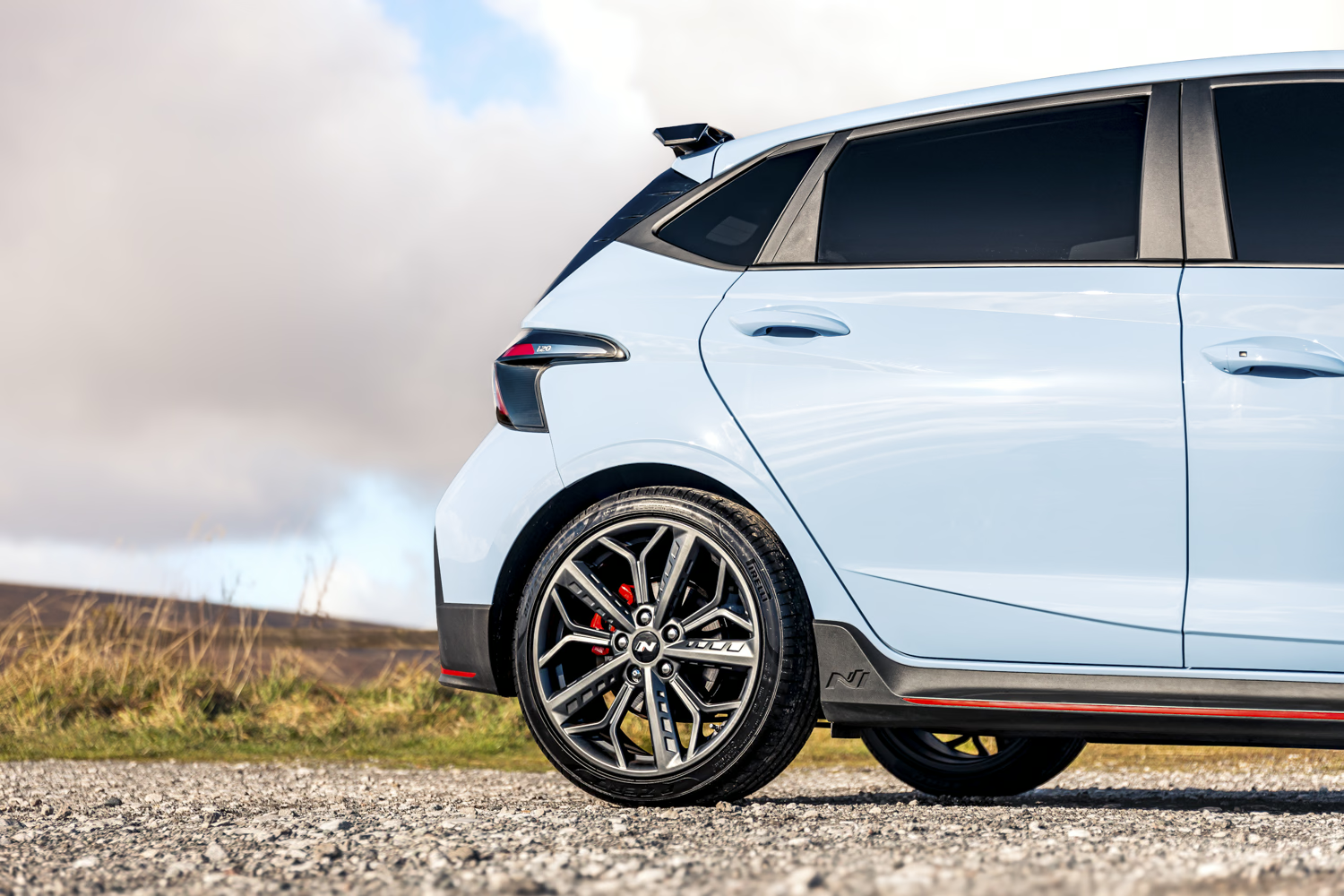
I'm fully aware that other hot hatches are still on sale such as the VW Polo GTI or Mini Cooper S, with a 'new' JCW on the horizon. But neither of these cars feel like they're putting the driver first. They change direction as if developed for someone who desires a sporty version of a regular car – not for someone who sets an early alarm to chase the thrill of a twisty road at first light. And given you're reading this publication, that probably means you.
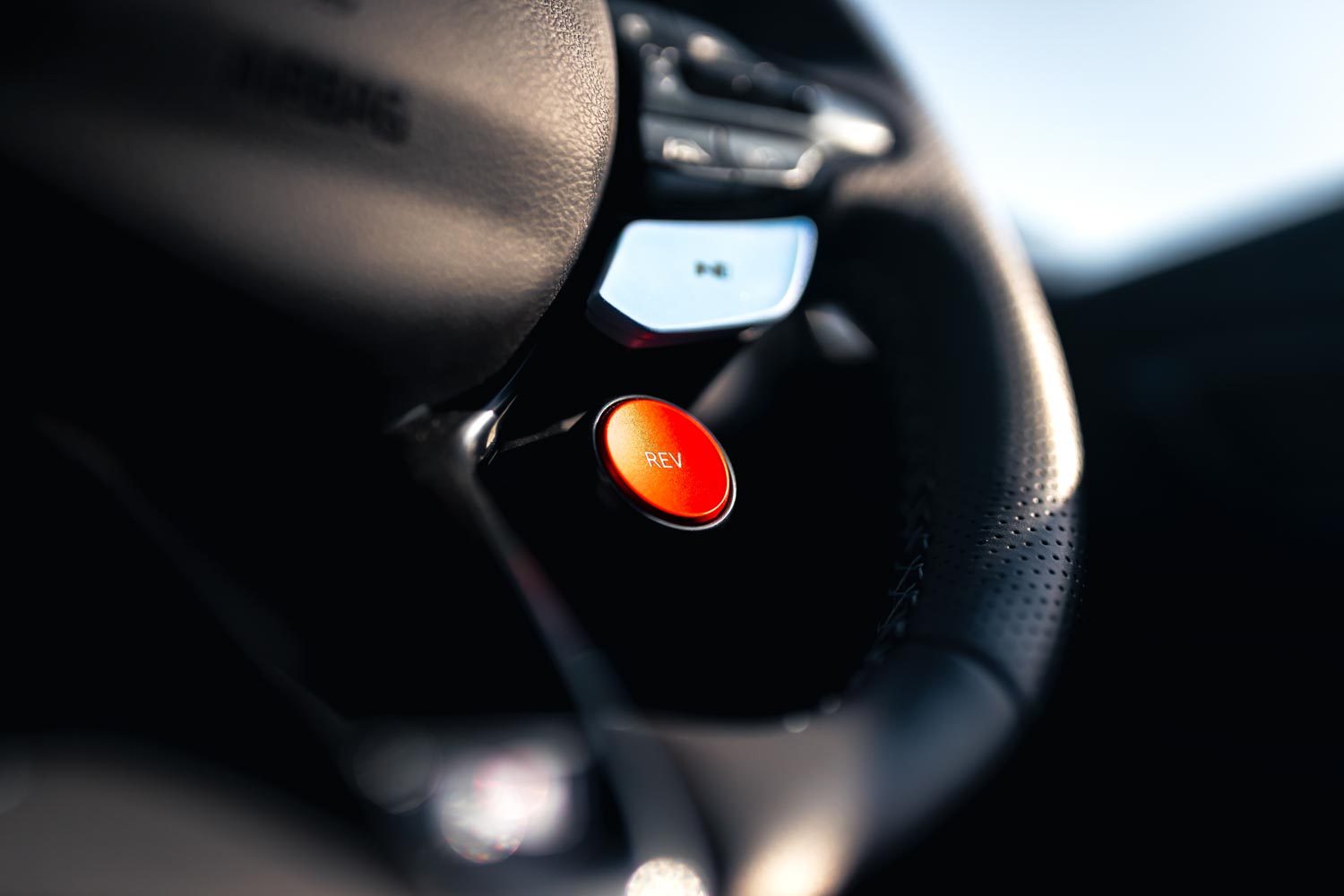
Visual aggression aside, the biggest clue that the i20 N has been developed by serious enthusiasts lies deep within its endless configurable modes. Now, some of it is gimmicky – you can't help but roll your eyes at features like the 'twisty road analyser' and the flambé that occurs within the instrument cluster whenever sport engages. But once you get past the marketing fluff, what stands out is how much of the configurability actually has a tangible consequence on how the car feels and behaves. It's something only a driver-focused engineering team would understand. Handily, you can dial in two custom modes, quickly accessible via the N1 and N2 buttons on the steering wheel, just like a BMW M car.
That doesn't mean the i20 N is a car masquerading behind its electronics. The hardware changes go far beyond the usual firmer suspension, thicker anti-roll bars and tweaked geometry. The chassis has been thoroughly reworked, with twelve additional welding points and reinforced front bracing compared to the regular i20. The track width has been increased, and the steering rack has been sharpened. But the big news is the mechanical limited-slip differential (LSD), which Hyundai developed in-house for the car rather than using an off-the-shelf item. Pirelli is on board too, developing a custom 'HN'-marked P-Zero tyre for the 18-inch alloys. Serious stuff for an entry-level hot hatch – but how does it translate to the real world?
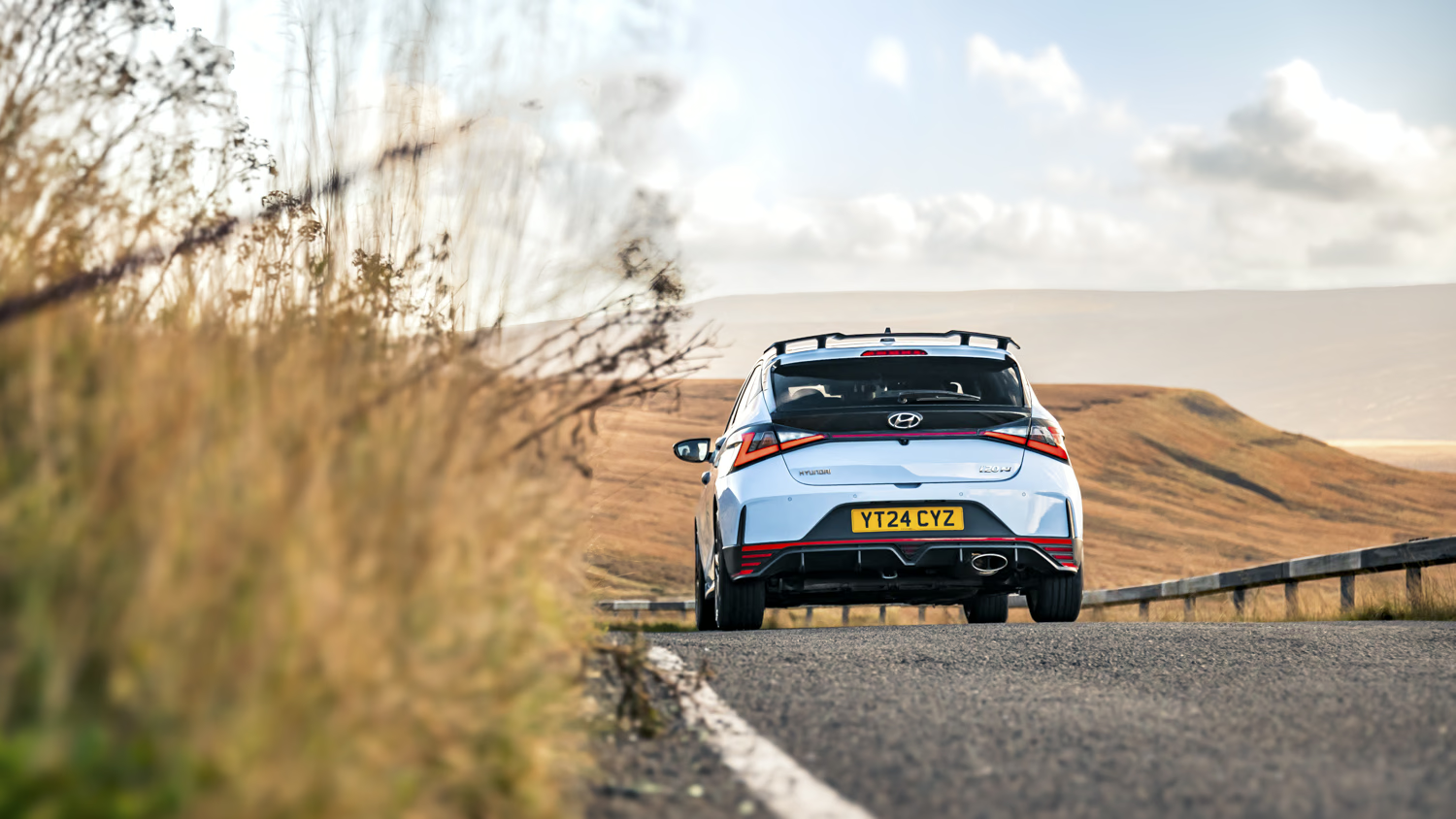
"It's not long before you're accelerating and cornering like a kid swinging around a lamppost, the i20 N encouraging you to keep the speed up, grinning like a buffoon the whole time"
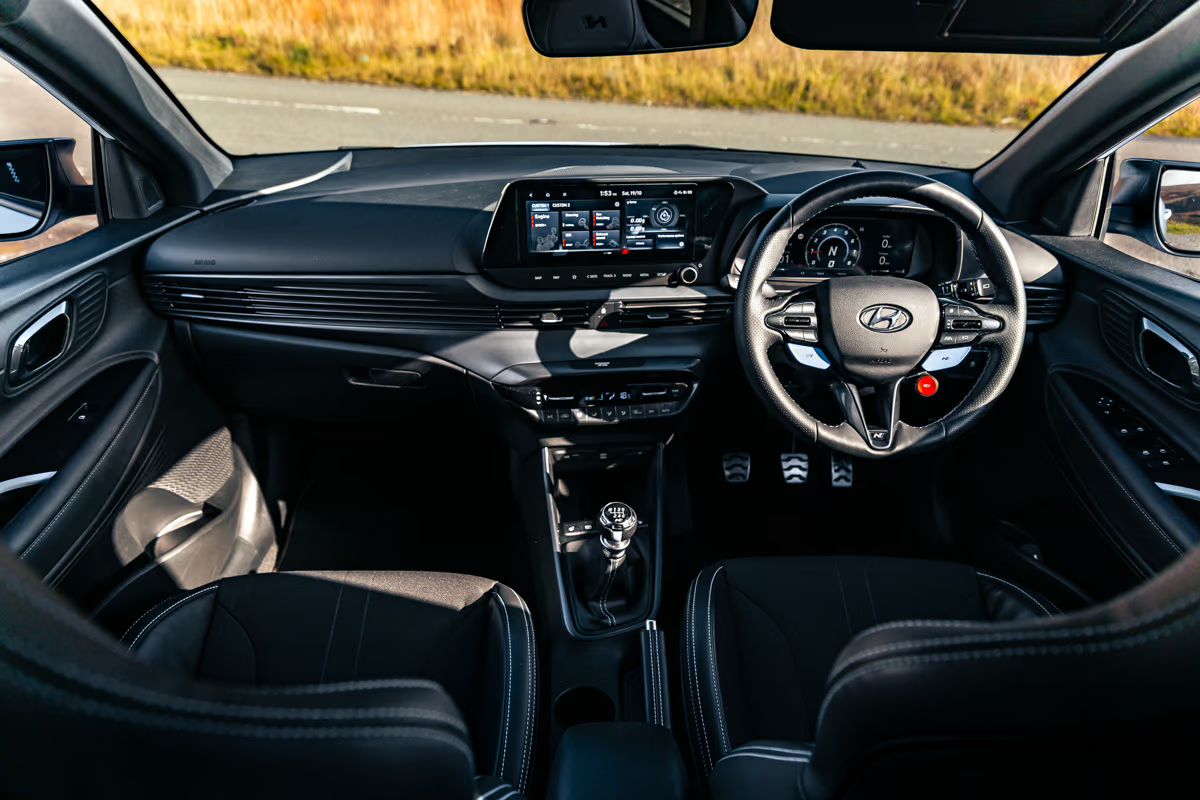
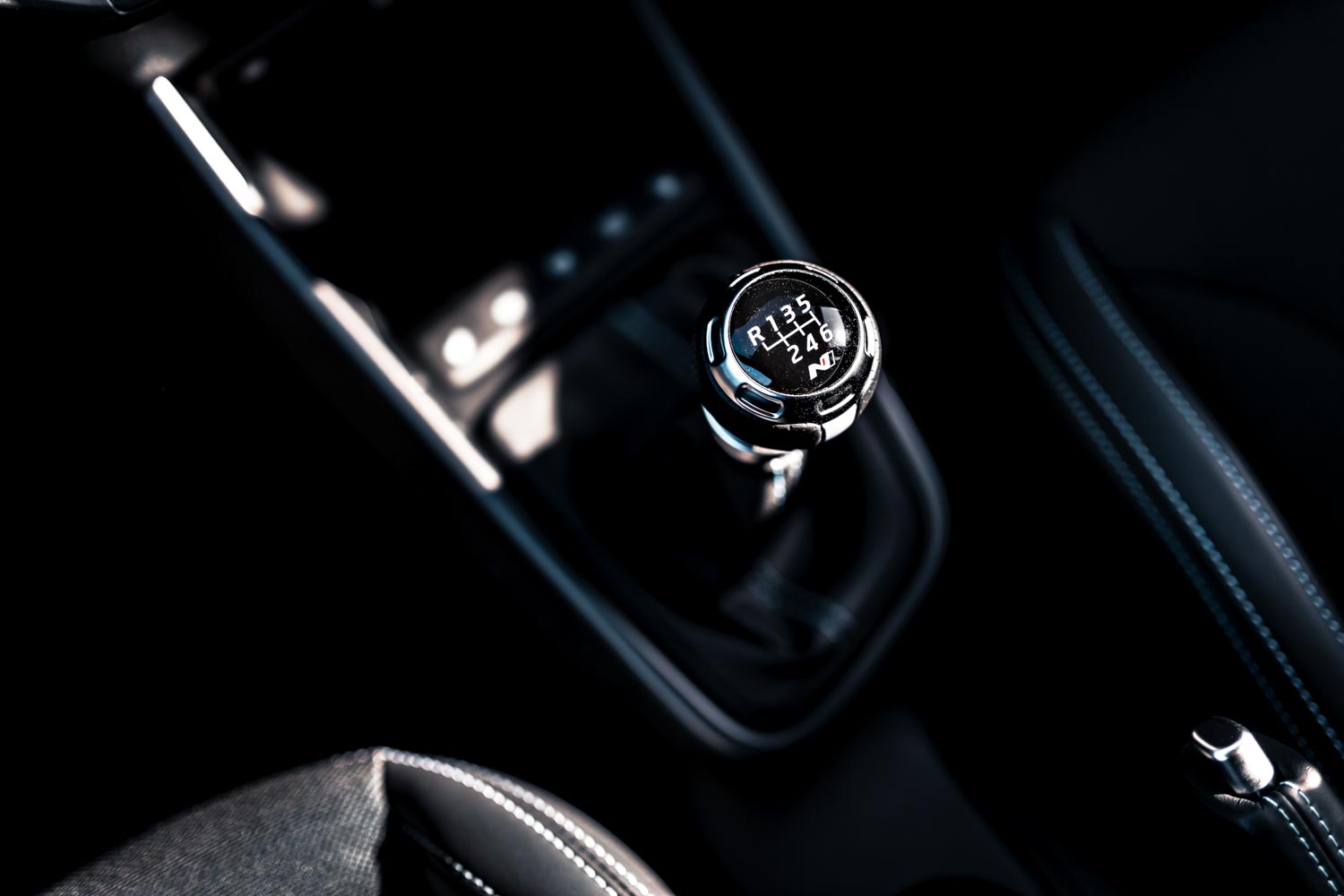
With quite a firm ride, it must be said, though controlled is perhaps the better word. You're always aware of the road surface beneath, but it never unsettles the car. The dampers aren't adjustable – think of them as passive-aggressive rather than passive – but the trade-off is a planted feel that inspires confidence. The steering is weighty and precise, the brakes are immediate, and the gearshift is slick. Only the slightly awkward biting point of the clutch ruins the party. The control weights might not have the ultimate polish of the Fiesta ST, but it's a fine margin – and the Hyundai counters with a far more natural gear lever position. The overall interior aesthetics and layout also better the Ford. Yes, hard plastics are present, but the N-specific touches like the Performance Blue highlights and chunky steering wheel give it a performance-oriented feel.
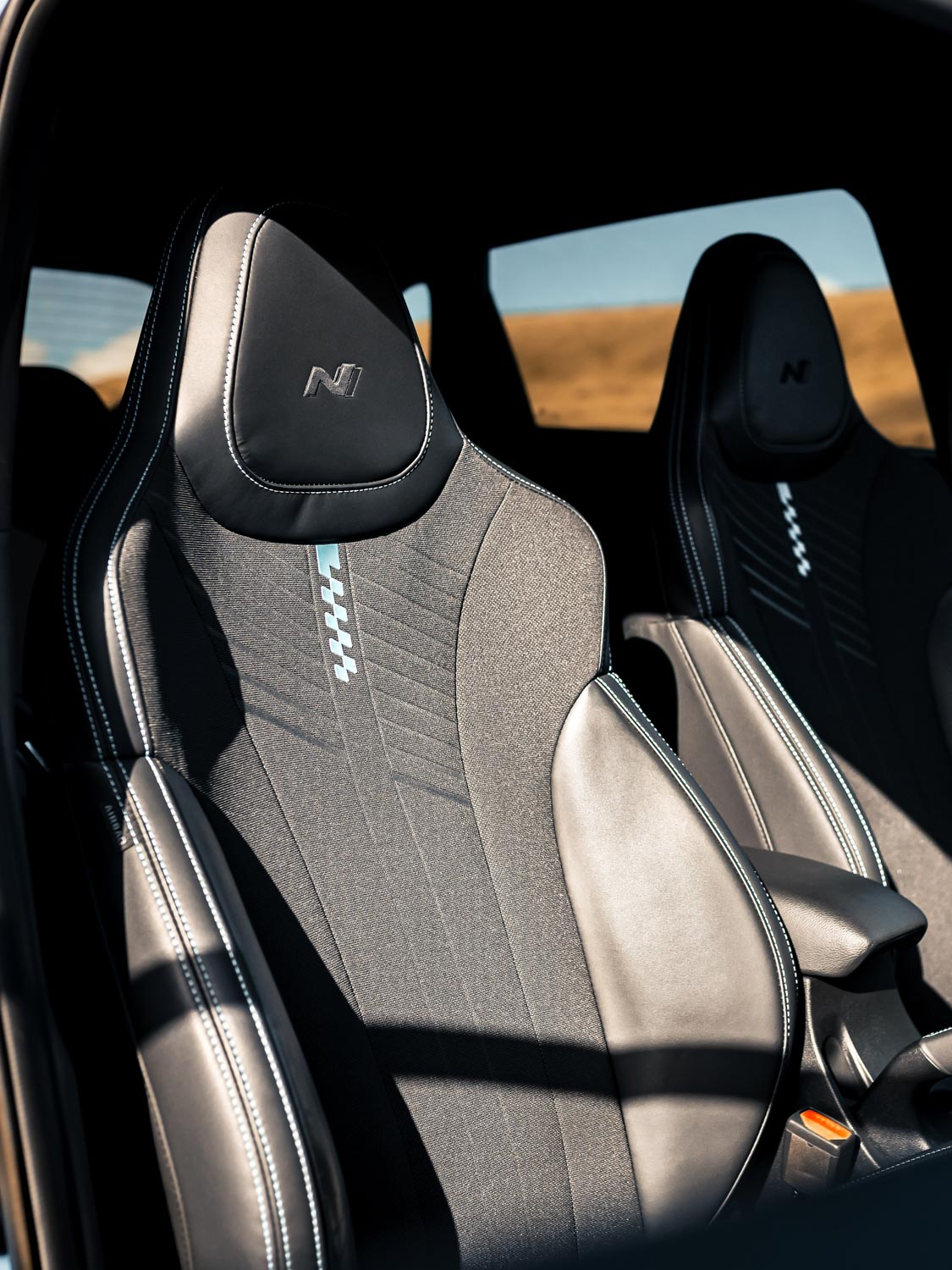
The driving position also scores points in favour of the Hyundai. Oddly, the steering wheel doesn't adjust for reach, but few cars these days give you that desirable feeling of being nestled within a car, however the i20 N is one of them. The bucket seats also strike the ideal balance between support and comfort: the padding is firm but never numbing although, a word to the wise, the leather bolsters aren't of the highest quality, with many owners complaining online about creases developing.
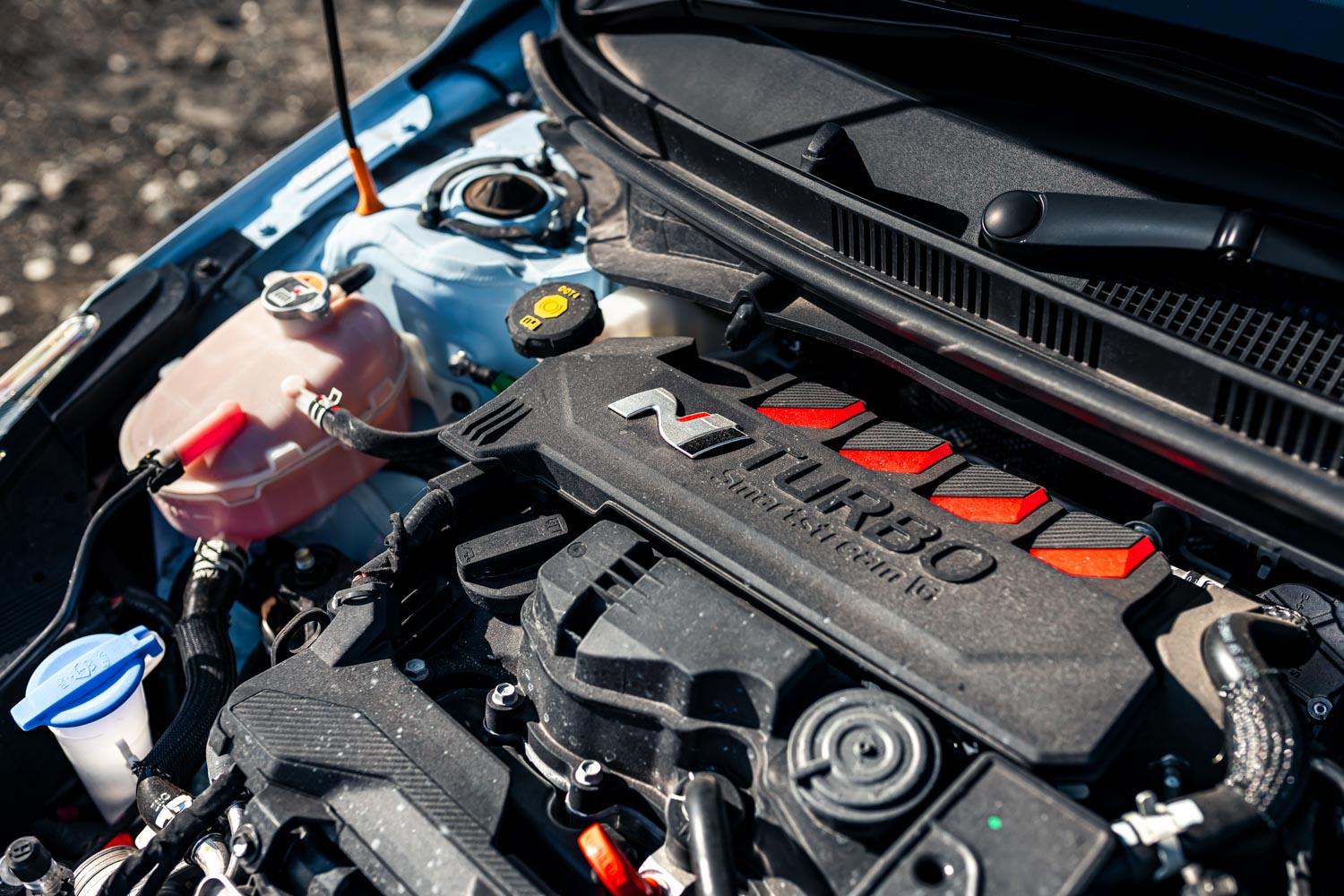
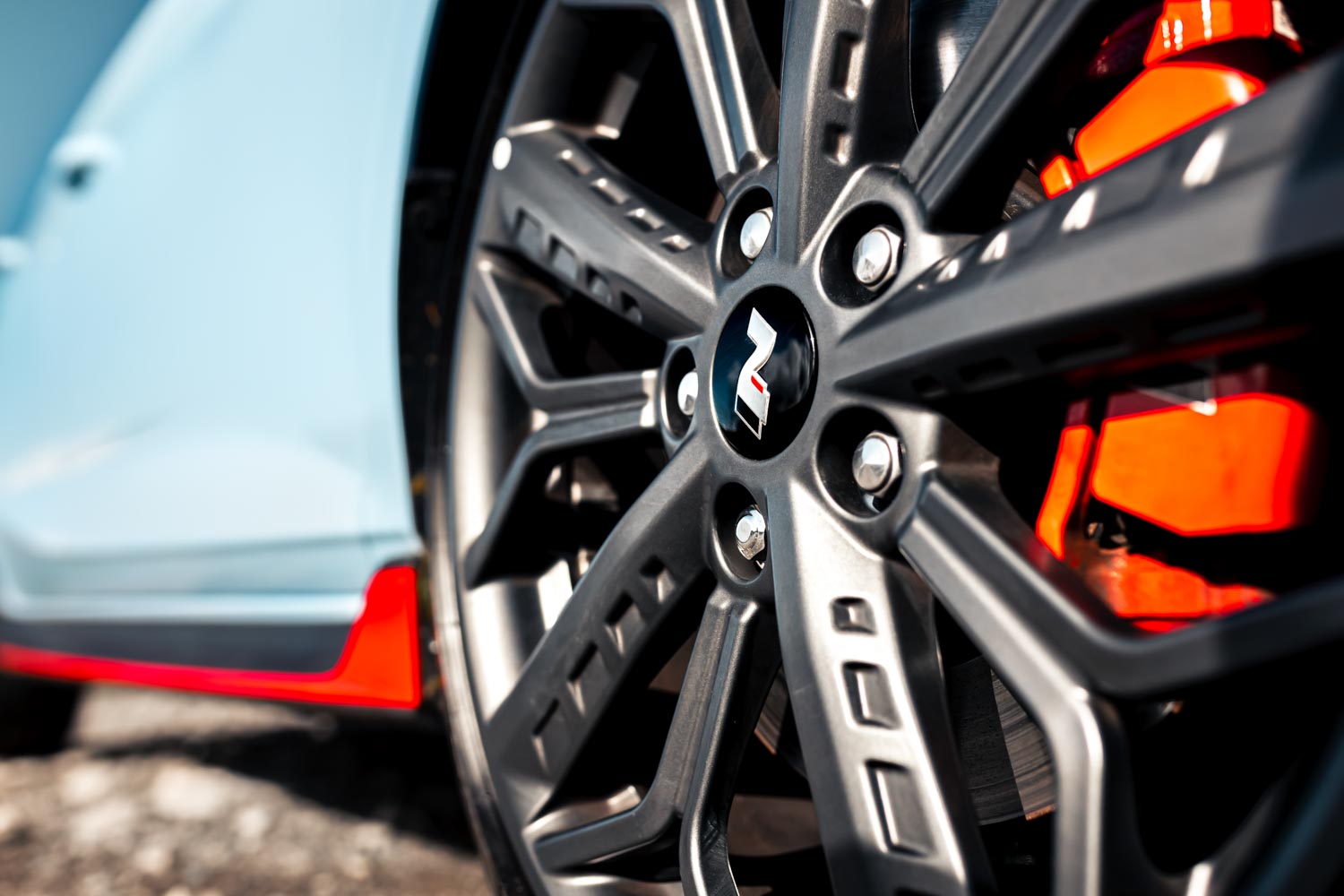
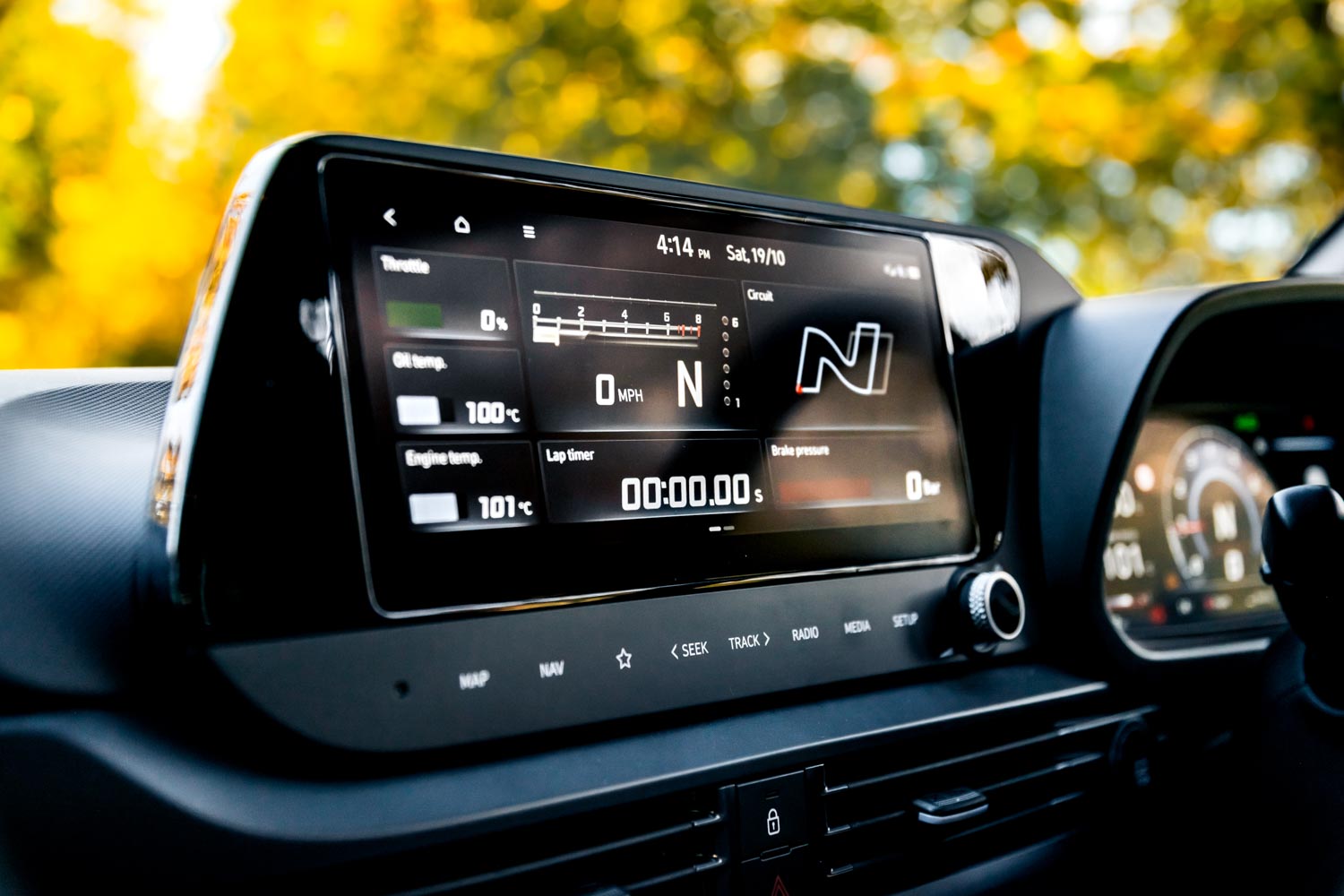
Plying its trade in the background is the turbocharged four-cylinder engine, the tone of which has been plagued by the adoption of piped in synthetic sound, and it's not of the well-executed kind. Thankfully, the volume of the symposer can be tailored, and there's a valve in the exhaust that can be switched between burble and boisterous depending on your mood.
Speaking of gadgets – the list of standard equipment is long enough to make Q blush. Apple CarPlay? Check. Heated seats and steering wheel? Check. Main beam assist Xenons? A reversing camera? Wireless phone charging? Absolutely. Not so long ago, all this was the reserve of premium German manufacturers, but now it's present in a Hyundai supermini. In fact, the only options available were metallic paint, a contrasting black roof, and an upgraded Bose stereo. With 5-door practicality and a 420-litre boot, there's even room for a young family. Everyday sensibilities? Covered. Heck, there's even a rear USB port.
Despite being laden with tech, the i20 N isn't weighed down by it, tipping the scales at a lean 1,190kg. That's impressive, given that fifteen years ago, the Renaultsport Clio 200 weighed the same and was one of the lighter hot hatches of the late 2000s. I do wonder, though, how much of that mass is concentrated in the flywheel, given how it sheds revs with real lethargy. Early cars had it the worst, carrying on accelerating even when the driver lifted off, but Hyundai was aware of the problem and issued a recall to tweak the software. The car still doesn't offer much engine braking, but it's more trustworthy than before. Despite the well-placed metal foot pedals, the auto blip rev-matching quickly becomes essential due to the problem. One oddity: why can the level of the rev-matching be adjusted? Surely, there only needs to be one setting for that.
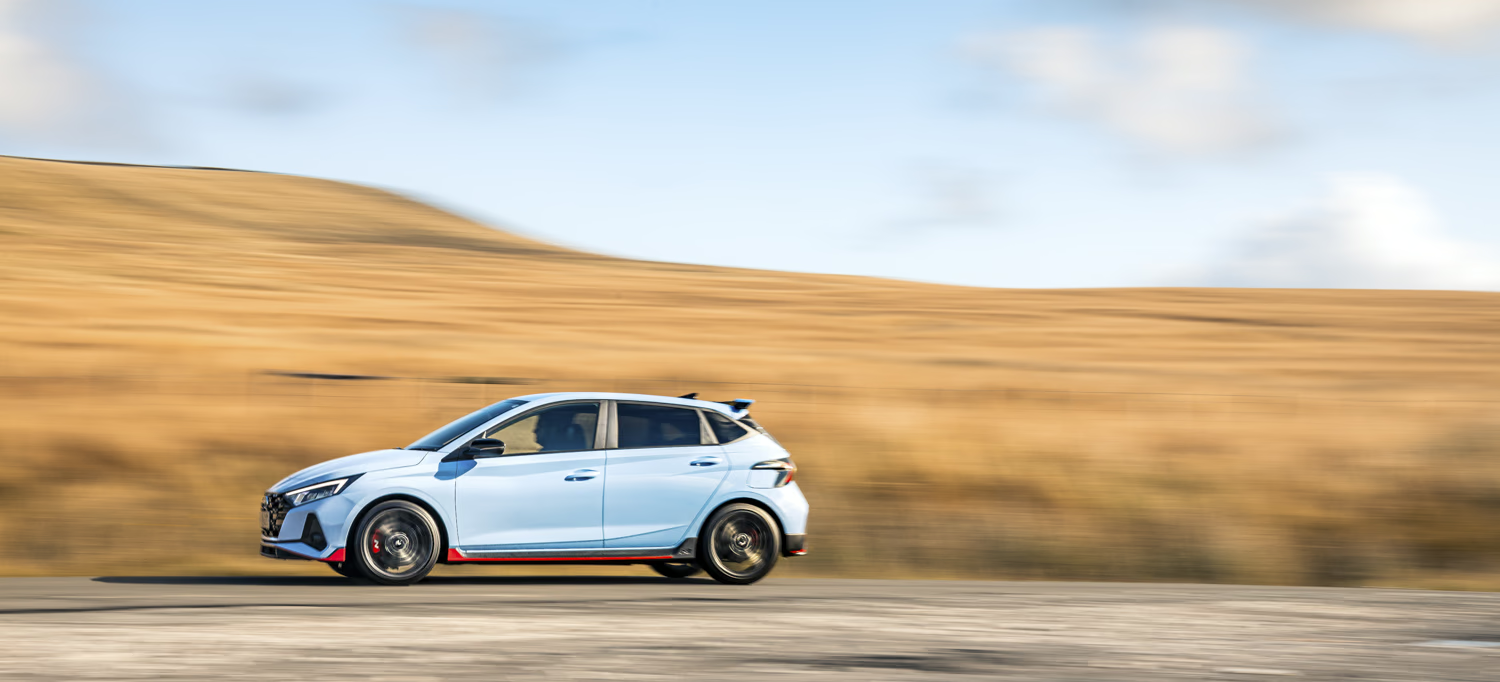
When it comes to acceleration, the outright straight-line performance perhaps isn't as impressive as that 6.2 second 0-60 mph time would have you believe. Yet the i20 N has strong real-world performance because of an overboost function permitting the car to produce 304Nm (224lb-ft) from 2000 to 4000rpm. Hyundai doesn't specify the parameters of the overboost, but when it expires, the fallback output is 275Nm between 1,750–4,500rpm. Peak power of 204bhp is delivered at 5,500rpm and held until 6,000rpm, making revving the 1.6 a worthwhile – if not thrilling – pursuit.
Out of the three available throttle maps, the intermediate setting offers the best balance of response and modulation – Sport is too eager and front-loaded. In the past, hot hatches were known for their free-revving, firecracker engines that rev freely, but here, the i20 N falls a bit flat. Consider the engine more of a support act – the bass guitarist to the chassis's lead.
"The differential is the star of the show – as effective as it is subtle, reminiscent of the Torsen diff in the Megane R26.R"
And the chassis is about to take centre stage, because the i20 N is an absolute joy to punt down a twisty back road. The differential is the star of the show – as effective as it is subtle, reminiscent of the Torsen diff in the Megane R26.R. Tightening your line with it becomes a huge source of satisfaction. It's not long before you're accelerating and cornering like a kid swinging around a lamppost, the i20 N encouraging you to keep the speed up, grinning like a buffoon the whole time.
Hyundai amusingly named the diff the 'N Corner Carving Differential – a mechanical LSD'. No doubt the abbreviation (m‑LSD) is a nod to chief engineer Albert Biermann's past life.
.avif)
That doesn't mean the i20 N is too single-minded. It'll still act the fool with a calculated lift on turn-in. However, this is still a car that gives its best the harder you push: fast in, fast out. Crucially, the Hyundai gives you options. It can match your mood – neat, tidy and quick, or fast and frantic – rather than forcing you to adapt to it. Don't underestimate it if one fills your mirror, spoiling for a fight – with its chassis and gummy tyres, the i20 N has serious cross-country pace.
Strong, tireless brakes complete an impressive dynamic package. They're immediate without being overly grabby, letting you modulate inputs with precision – whether that's around town or trail braking on a track day.
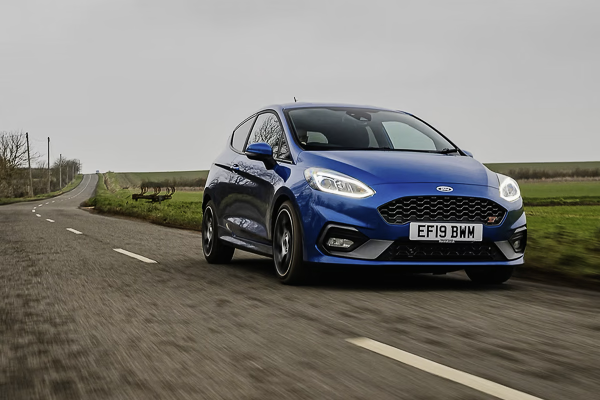
Where the Fiesta ST feels more playful with its tail-happy rear, the i20 N feels more planted – almost unflappable. The Hyundai's extra grip and precision make it the more serious of the two, though the Ford's mischievous nature still has its charm. If you're caught on the fence, it's worth noting the Ford's longer production run means they're more readily available – and cheaper. The Hyundai's relative rarity is propping up residual values, making the i20 N a significantly more expensive proposition on PCP.
By the end of my time with the i20 N, even the digi-gimmicks had won me over. Yet they never detract from the driving experience. More importantly, the car's ability to be unapologetically impish with the exhaust valve open and the differential clawing for traction one minute, then quietly cruise at 50mpg the next, is hugely appealing. Especially when you want to sneak out of the house at 5am for a drive. And you'll want to in this car.
In the past, I criticised my old Toyota GR Yaris for having too split a personality. But in the Hyundai, that duality is an asset. It might not be as technically impressive, but it's more immersive. The Yaris has a speed-to-joy bandwidth of 90:10, meaning you need to be pushing close to its limits before it really comes alive. The Hyundai unlocks earlier, more like 70:30, and then has another final 10% when the differential wakes up. Seven times out of ten, I'd take the i20 N for a back-road blast over the Toyota – the simple truth is it's more fun, more often. Let's be honest, few buyers will cross-shop them, but if the mark of a truly great car is its ability to transcend class boundaries and invite comparison with more hardcore machinery, then consider the Hyundai's talents affirmed.
Like James Bond, the hot hatch will return. But it'll be in a sanitised form as modern sensibilities and electric propulsion take over. Just as the hard-drinking, womanising secret agent is fading into the past, so too is the fossil-fuel-burning, Walther PPK-exhaust-equipped hot hatch.
And much like Daniel Craig's Bond, the i20 N serves as a fitting finale – a last hurrah for the ICE hot hatch we know and love. As the curtain falls, I urge you to Rush out and buy one while you still can.
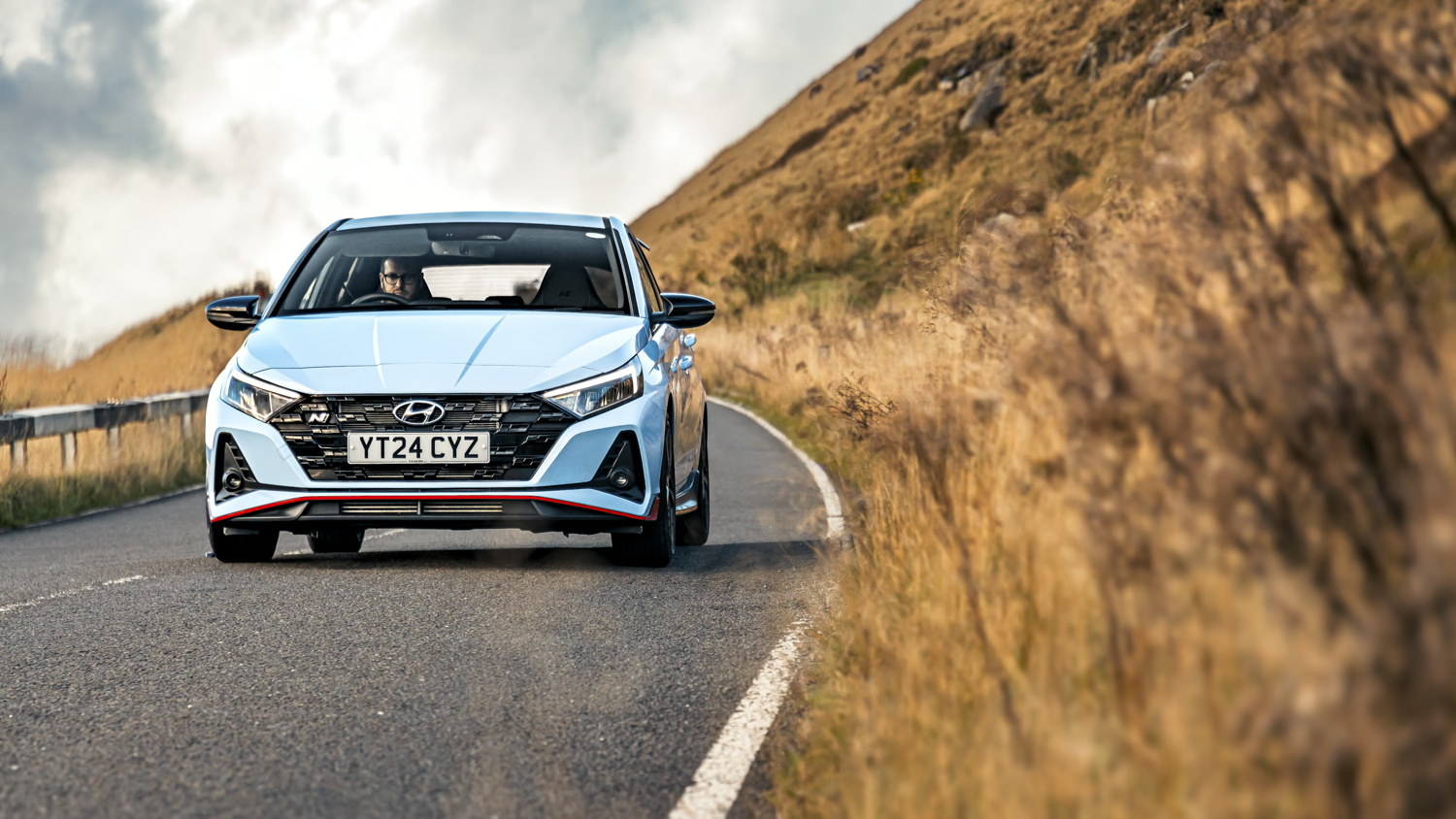
Hyundai i20 N: The Rush Verdict
The Good
Hilarious cornering ability and giant-killing real-world performance backed up with classic hot hatch character – yet equally refined when you need it to be. Big-car tech in a small-car footprint. Strong residual values.
The Bad
Ride might be a little too firm for some. Overly artificial noise in Sport mode. Needs driving hard to extract the biggest grins. Lethargic flywheel. They've stopped building it.


.avif)
.avif)

.svg)

