-01.svg)

When it comes to high-performance Subarus, an S designation represents the best of the best – the fastest, the noisiest, and the most hardcore. Developed with learnings from competing in the gruelling Nürburgring 24 Hours, the S210 arrives with a host of track-focused upgrades to elevate the four-door performance saloon.
Power comes from a 2.4-litre turbocharged flat-four engine, codenamed FA24. Modifications from the regular WRX model include new air filters, intakes, and a revised exhaust system to reduce back pressure. An enlarged single-exit exhaust tip with a cannonball-shaped chamber, combined with bespoke ECU tuning, will deliver 296bhp at 5,700rpm, with 277lb-ft (375Nm) available from 2,000–5,600rpm. While in the same ballpark as modern hot hatches, the S210 has around 50bhp less than its predecessor – the S209.
As expected, performance is sent to all four corners. Unique 19-inch wheels wrapped in 255/35 R19 Michelin Pilot Sport 4S tyres shroud 18-inch drilled brake discs at the front, which are gripped by 6-piston Brembo callipers. The rear features 17-inch discs, and all callipers are painted red. The suspension setup comprises adaptive dampers, model-specific springs, and new rear bushes. One of the more visible chassis upgrades is the black and red strut brace found under the bonnet.
Visually, the S210 is set apart from the WRX range with an enhanced bodykit, made up of an enlarged front splitter, new side sills, black headlight surrounds, and a fixed carbon-fibre rear wing that sits atop the bootlid.
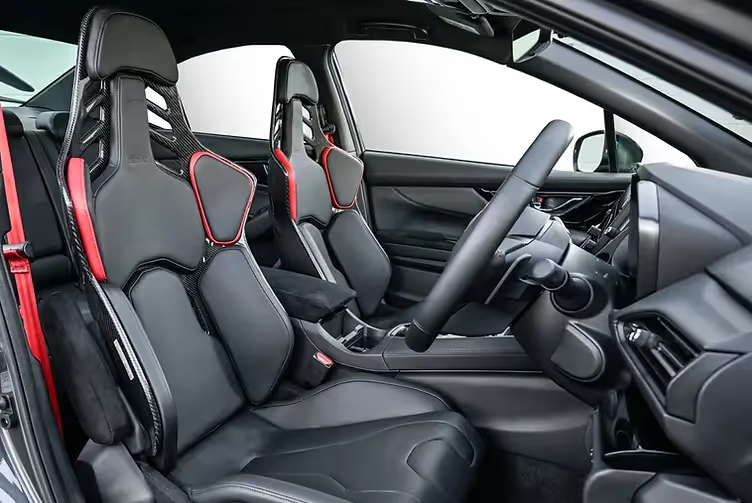
Inside, the car gains two-piece carbon-fibre Recaro bucket seats, upholstered in nappa leather. Most of the interior surfaces carry a black finish, with red contrast stitching found on the seats, front seatbelts, steering wheel, and gear selector. As only 500 S210s will be made, a commemorative plaque with the car’s serial number can also be found in the cabin.
Upon closer inspection, a potential issue starts to rear its head with the new STi – and it’s not the lack of gold wheels or the electrically adjustable seats. The fly in the ointment lies somewhere in the middle – quite literally – as transmitting the 296bhp and 277lb-ft to each corner of the drivetrain is the brand’s automatic Subaru Performance Transmission.
That sounds fine on face value, as most modern performance cars come equipped with only two pedals, but some more research reveals that the gearbox in question is a CVT. This means that in normal use, the automatic gearbox will pick an engine speed depending on how much power the driver has asked for, and the revs will remain there as the car’s speed increases. This is commonly referred to as “rubber-banding”, which sounds unnatural to the untrained ear, but the car delivers linear acceleration with no need to interrupt the power delivery to switch gears.
Thankfully, this isn’t the only way that the gearbox behaves – and if you’ve read anything to the contrary, then you have been misinformed, dear reader. A number of ratios can be manually selected via the shift paddles, and the powertrain will behave like a traditional automatic. The second-generation Mercedes-Benz A-Class launched in 2004 with a CVT automatic that would also let the driver choose from seven ratios in its “manual” setting.
Subaru states that the S210 is still in prototype form, with further tweaks to be made ahead of it going on sale this spring. Having departed from the UK market over a decade ago, the new WRX STi S210 is the latest example of a forbidden fruit that will never officially grace the roads and forest stages that played a starring role in forging its reputation.


-2.avif)

.svg)

