Who are you and what is your role at RML?
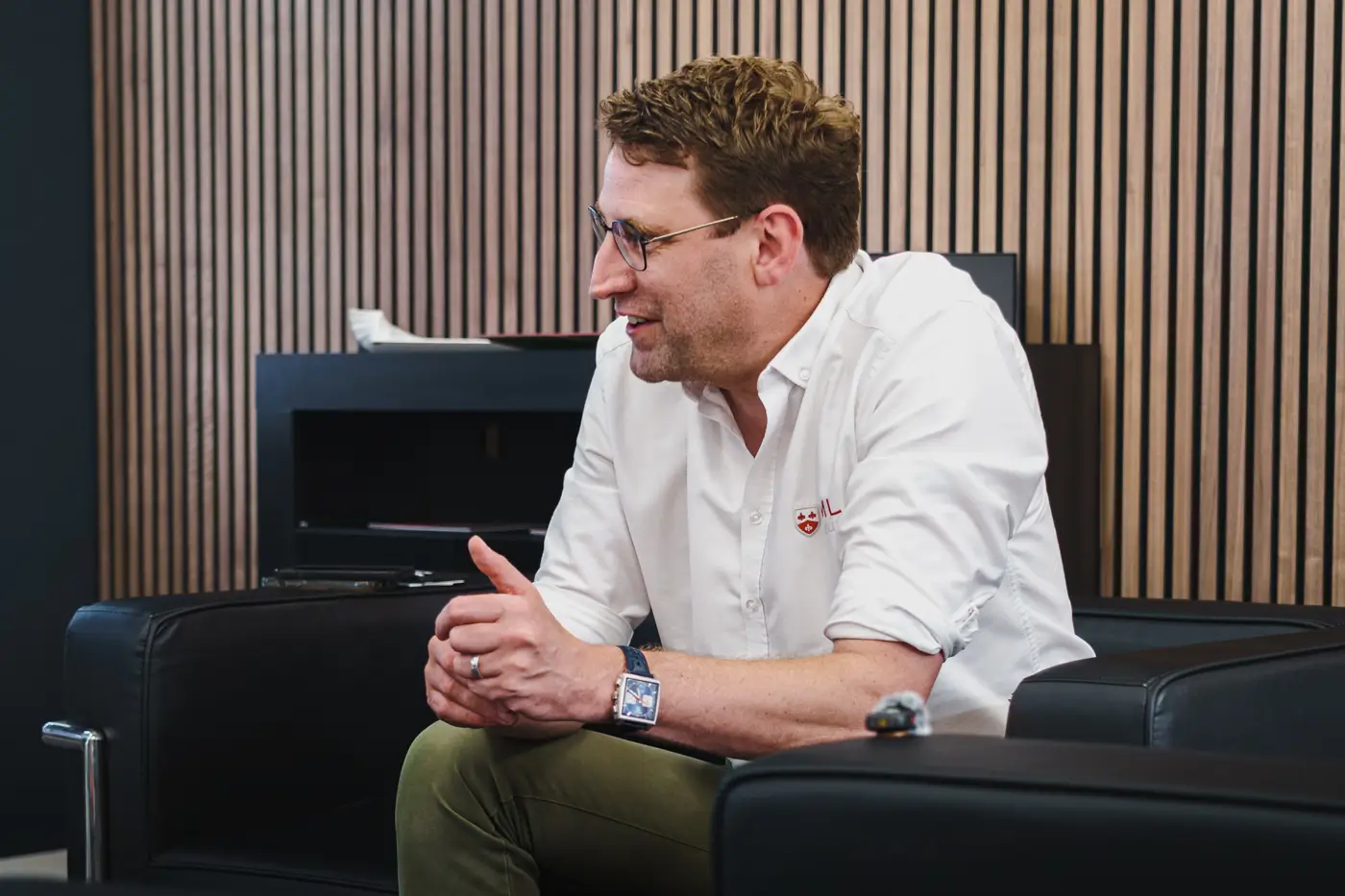
I’m Paul Dickinson. I’m the Chief Executive Officer here at RML. And I’ve been here two years.
You’ve got to love cars to be in this industry, and you’re a bit of a professional petrolhead. So what have you got in the garage and why? What has been there and what would you like next?
I have two cars in the garage. One will stay there permanently – my 1998 Mini Cooper. I bought that new for my 17th birthday when I joined Rover Group as an apprentice. It’s the brochure car, so it’s in Tahiti Blue, has multi-point fuel injection and airbags. It became the best Mini they’d ever built.
At the moment, on the other side, I’ve got a 1974 XJ6, which I moved to having had various sports cars because my children are getting bigger. They’re seven and 10 and they don’t fit in the back of a sports car. So I needed something with back seats and rear doors so I can actually do stuff with my family because as you can see, I spend my week away from the family in Northamptonshire, and they live in Cheshire. I can’t just go home and say, ‘I’m just going for a drive in my sports car on my own for the next hour’ – it isn’t going to happen.
If I ask, ‘Why don’t we all go for a family picnic in the Peak District in my Jaguar?’ then I’ve got a chance!
I’ve had quite an eclectic mix – they’ve all been British bar one. I had the actual Rover 200 from Keeping Up Appearances. That was cool. It had the 1.3 Honda engine and it was amazing. I’ve also had an XJS, a Stag and a TR7, but my one non-British car was a Toyota MR2 Series 2 that I took as a part-exchange when I was selling my Lotus Elite. I absolutely loved it but it was an absolute nightmare of a car.
I had it for nine months, I really liked it – it was white with a fully blue interior which was so ’80s. I actually ended up selling it to one of the team at RML who’s in charge of our chassis engineering and I do occasionally see it in the car park here.
How did Project 39 – which then became GT Hypercar – come about?
When I joined, the Ferrari-based Short Wheelbase product was just coming to an end. That was in a very different market segment than the Porsche at just under £2,000,000. It was a great technical project, but commercially challenging from a brand point of view. That’s a great car for me to take to an OEM and go, ‘Here’s the standard of quality, build and finish we can do.’ Boom. But from a customer point of view, it’s a very expensive car to buy from a company you’ve never heard of.
So when I joined we did some work and decided we need to make it clear what we do with the four business divisions: Power, Engineering, Motorsport and Bespoke. The whole point of Bespoke is to make cool cars, revenue, give customers experiences and demonstrate our capabilities.
Would you call it a tech demonstrator?
It’s more than that, it’s more a capability demonstrator.

How did you settle on a Porsche-based project for Project 39?
There were three or four different ideas on the table, and we ended up focusing on the Porsche – and that was relatively easy to make as our heritage is motorsport and high-end engineering. The projects we work on should use our motorsport and high-end engineering skills, in a package that other people couldn’t do, except one. Having learnt from the Ferrari experience, we wanted our donor car to be the best possible donor car you can have, so we’re not fixing it, just enhancing it. And then further to that, we need to have some kind of story that makes sense.
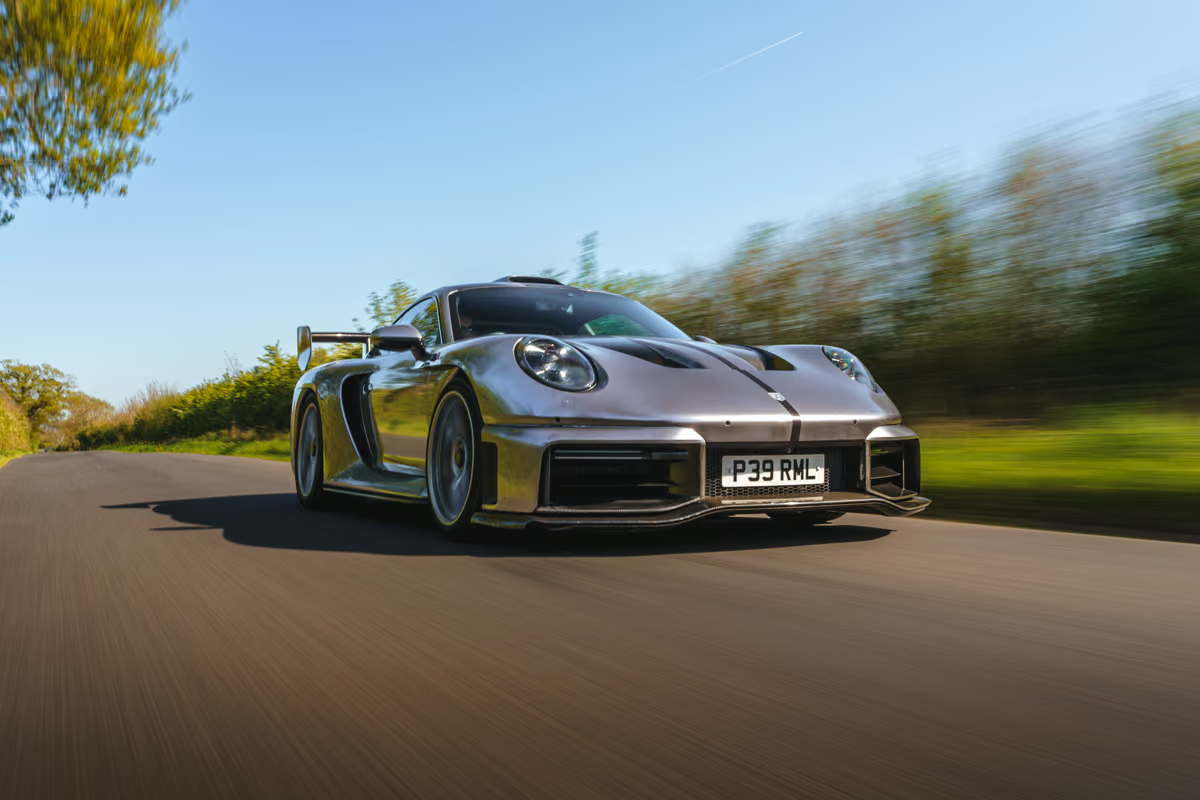
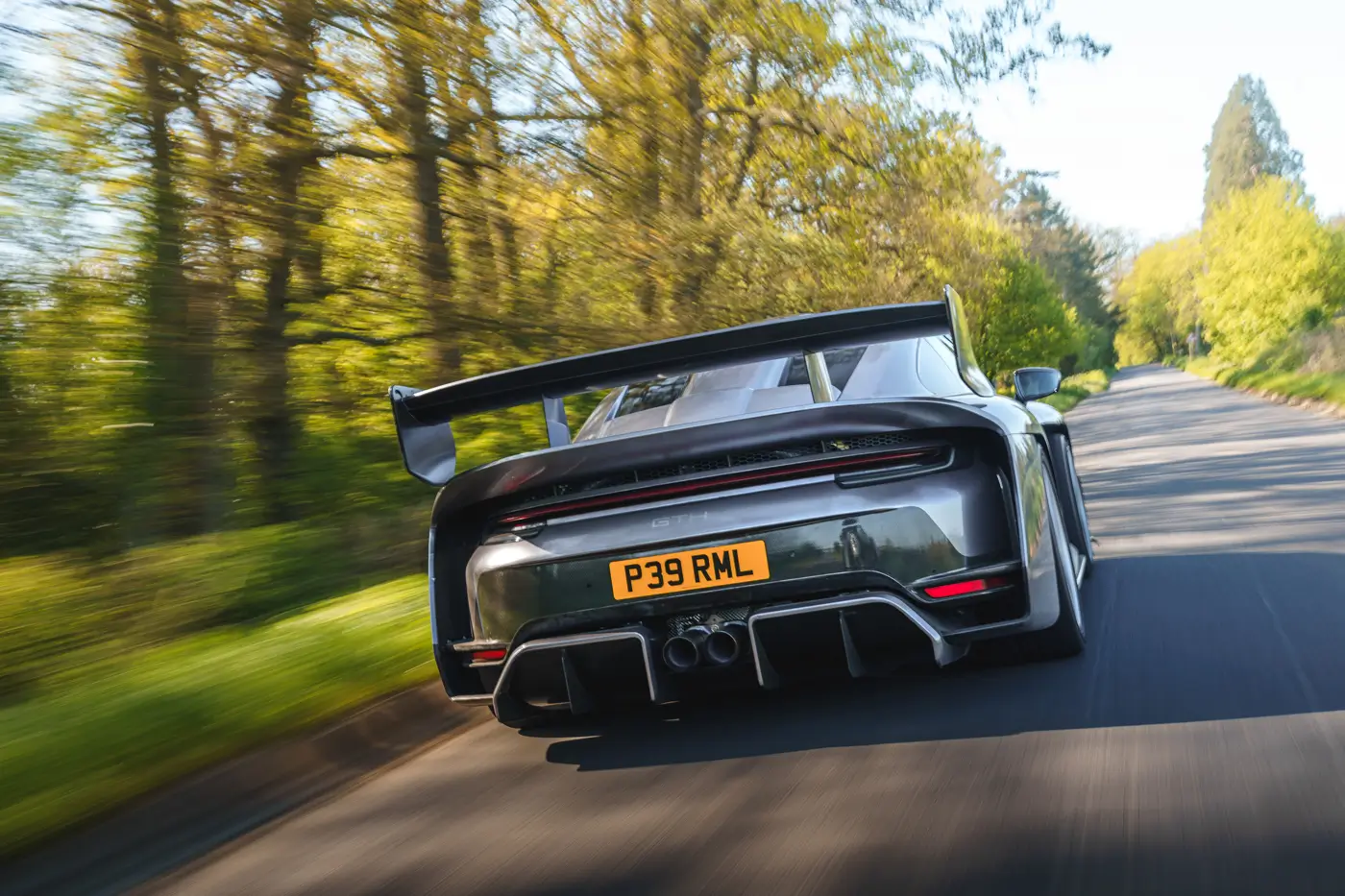
It was a team effort to come to this conclusion: it’s easy to make a fast track car. What’s difficult is to make a car that’s usable on the road and amazing on the track. So why don’t we give ourselves that problem? Let’s go and solve that problem. How do you make a car that can be a great GT car and a brilliant hypercar? Hence the name: GTH – GT Hypercar.
That’s when we started looking at what we could do. The 911 Turbo S is a perfect donor. It’s a great road car but not the best track car. A GT3 RS is an amazing track car, but challenging to use on the road as an everyday car for more than 20 minutes – you don’t want to drive it to the Nürburgring. So what we set ourselves with this car was to engineer a car that you can drive to the Nürburgring comfortably, do a lap as quick as a GT3 RS and then drive it home. That was the challenge the team accepted. We agreed that project at Pebble Beach 2024, and that’s when Customer 1 – who has the purple car – said, ‘Yeah, you’ve got to do this!’ So we came back and officially kicked off the project.
From that moment, how long did it take to get from an idea to a running prototype?
We started the project in September 2024. By the end of November, we signed off the design, because the tooling would be production tooling, and we had to get the car on track for Supercar Fest in May. And the longest lead item was the front clam. So nine months from an idea to a running car and production tools blows your mind.
That makes China seem slow.
It does. And then it’s less than 15 months until the first customer car is fully validated. And it’s a lot of tech; this is not a simple car. The initial sketch was on a napkin – as all cool things are. We designed it fully digitally in goggles, then engineered it digitally by taking a donor Porsche apart, scanning it, getting it into CAD, doing all the CFD and the chassis dynamic modelling.
Compared to the previous roadgoing project…
Short Wheelbase took four years and a lot more money than this has taken. But this demonstrates our capabilities and our credibility – it makes sense why RML, a multi-championship race-winning car team, who’ve done lots of OEM White Label projects, high-tech engine development, electrical, suspension and chassis engineering, would do a high-performance Porsche that’s also a good road car. It makes sense.


Let’s talk about the development of the car beyond the overall concept. How did the design and engineering come together?
You have to make lots of conflicts to then agree what you’re going to do. For example, we have to leave space for the big high-pressure hydraulic unit (HPU), and we need to get the air through because, with an aero-focused car, it’s all about reducing drag everywhere we can, so you can then put downforce where you can control it.
Its straight-line speed is not amazing flat out because it’s got so much downforce, but it’s got an amazing pace round a track. So to accommodate the HPU we lose the frunk anyway because we need to let the air flow through that, from the radiator over the top. So in theory we can make it a one-piece clam with no opening front. And I said, ‘Where’s the washer bottle? Where’s the battery? And the fuel for the flap.’ ‘Oh, yeah, we’ll make a flap for all that stuff…’ The answer was no.
So then the suggestion was, why not make a lift-out panel? Design says no as they want it to be as smooth as possible and that would introduce panel gaps. So what about a lift-out bonnet? I said, ‘What?’ If a customer drives to the Nürburgring and needs to fill up their washer bottle, they have to make a new friend at the petrol station to help lift off the massive clam with headlights and put it on the floor without scratching it? No, that’s not usable performance. We came to the conclusion that we had to engineer a fully opening front clam so all the service items can be reached.
How did digital tools help the car go from concept to reality? And is AI a part of your engineering process?
Yes. There’ll always have to be a balance between how you get to the finished product with AI and tech, and then how it actually feels on the road in different circumstances. What the tech does is it gets you closer and closer. So in the past, you might have had to refine it bit by bit. Now, we can get very close to how we want it, and only have to refine it a little.
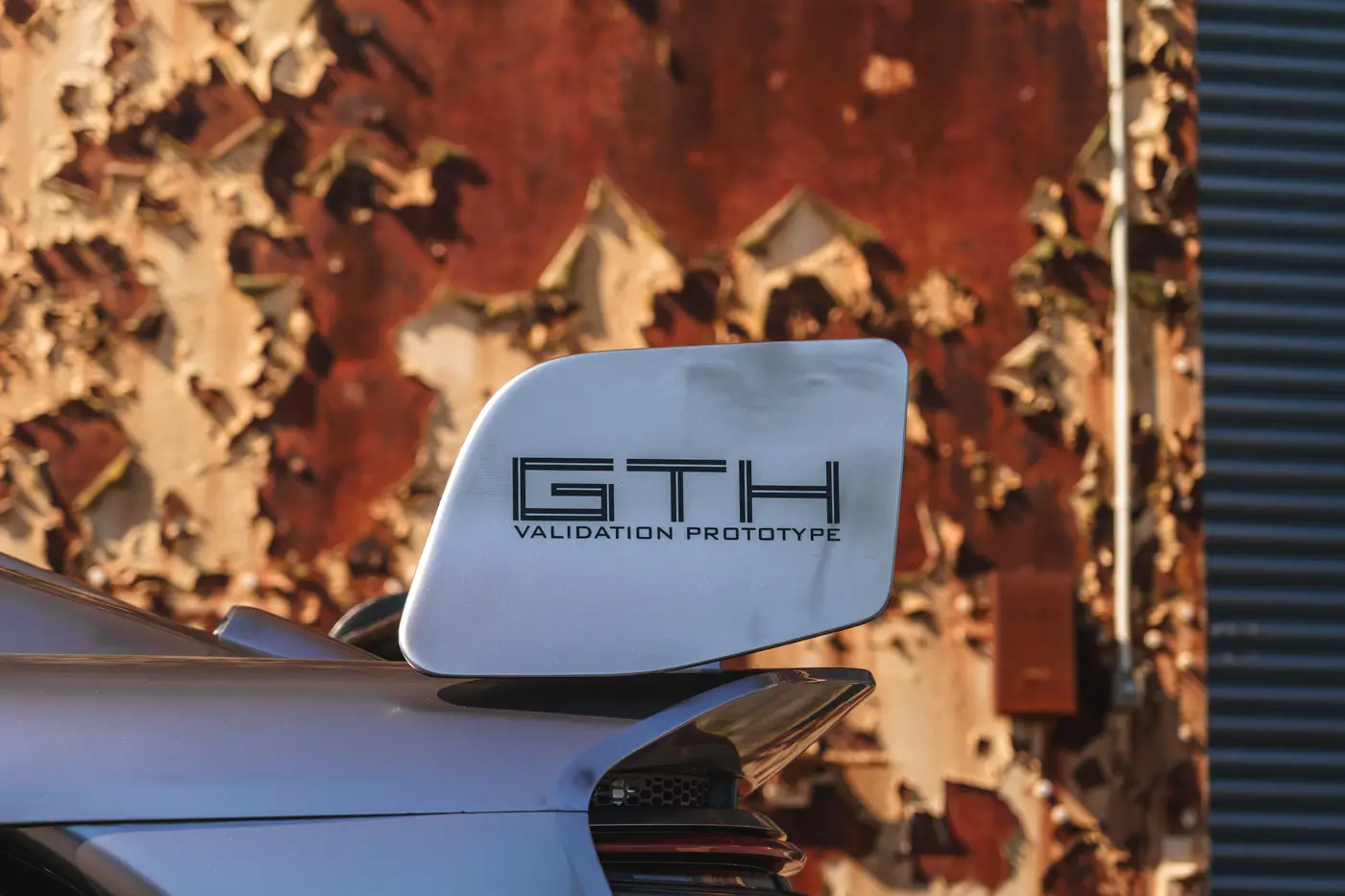
With GT Hypercar, we went straight from digital to physical. No soft tool, no prototype. The prototype is a validation prototype, not a prototype prototype. On this car, we completely did everything digitally and we signed it all off in VR. The computer says the CFD is fine – just order it. Trusting that is something we may not have done even five years ago, but now it’s so much closer.
We didn’t soft tool the carbon – we hard tooled it. So the carbon parts fitted to Car Zero are completely interchangeable with the parts on every production car. Likewise, all the suspension, everything went straight from digital into physical.
When we got into it, there were a couple of the suspension components we decided to change based on feel, but mainly, the power we have digitally means that you go straight to production. So that’s why it took us nine months.
With the digital development completed, tell me about the real-world development.
So in the market we’re in, which is for a driver’s car, how it feels to the person driving it is what really matters. Tom Chilton is a former British Touring Car Championship (BTCC) driver, and he’s our development driver. His brother, Max, is the development driver for McMurtry so there’s a bit of a family rivalry going on there…
Tom did all our track development from it turning its wheels for the first time in May 2025 until the summer. At that point we were optimising it, because even though we did it all electronically, when it comes to final suspension set-ups, it’s all about how it feels. Especially considering we’ve changed the wheelbase and the track. As for the road sign-off, we actually did that as a team, driving Car Zero and finessing it through our real-world experiences.
For example, I’m so cool that each week, I conduct a brass band in Staffordshire. Every Wednesday night, I leave the office at 6pm, I drive two hours back to Staffordshire, conduct band practice, drive two hours back to Northamptonshire, and go to bed.
I do 250 miles and four hours of driving on a Wednesday evening and I have to not be in a bad mood when I get to the band, and on the way home I need to be able to pull into a drive-thru and buy a coffee.
The first time I was in Car Zero, none of the cameras or parking sensors were working, the exhaust was in loud-only mode. And then I turned up to McDonald’s in Leicester in a naked carbon GT Hypercar. I couldn’t get round the drive-thru, so had to do a 14-point turn to get out – with no sensors or rear window, and there were people everywhere in the car park. It was quite stressful. The takeaway: we needed more steering lock. I said to the team it’s not enough – the customer has to be able to take their car to Starbucks. So the new test was taking it to the one around the corner from here and seeing if you could get around the drive-thru in one.
We also had to retune the exhaust – initially at 70mph, even in quiet mode, it had a really annoying drone at 3000rpm. I said we have to tune that out: no drone, unless you press the button, then it can be noisy. The reason being so that I can speak to my wife, because I’m not going to see her all week. My two-hour drive back from band practice is where there’s no distractions, and I need to be able to hear her.

What else needed changing after road-testing Car Zero?
There was a lot of work on the ride height. Setting it up for track is relatively straightforward to do: drop an inch at the front, less than an inch at the back. That increases the rake, giving it a very pointy front end – unlike a normal 911.
Getting the road ride height right was really challenging. The designers want it as low as possible, engineers want it stable, I want to not catch the front. Initially nose-lift was only deployable up to 20mph. We doubled it because it did nothing much to the handling around town.
We got through a few front splitters on Car Zero. Initially, the whisker on the outer edge was bigger but we had to reduce it – I kept on catching them on the bumpy roads and off-camber T-junctions in Staffordshire. They’re really important because they control the airflow around the front tyres, and if I’m a customer who’s paid extra to have them in visible carbon and I scuff it, I won’t be happy about coming back and asking for a new one.
We put it through the computer which said we’d lose a certain amount of performance, sent Tom to rag it around the track and he said the feel of the car wasn’t any different. We repeated this until he could feel it, then took it back a notch. That’s the development you can’t do with a computer; it gives you the base, then you vary it based on how it feels.
How important was it to put the RML name on the car – and give it a new designation – for building the company’s profile?
I’m a big car guy, but I’d never really heard of RML until I joined RML. I had some involvement with the business when I was at Bentley and we were looking at Individual Vehicle Approvals (IVAs) for the continuation Blowers to be road legal. I’ve been in the industry for 25 years and the biggest problem is being known. I’m here to grow the business, so I’ve been going to the OEMs to show them our capabilities – and you can do that much better when you turn up with a car, or give them a GT Hypercar for a weekend and let them be surprised with how OEM it feels. One manufacturer certainly was.
I’m lucky enough to know senior people at lots of UK-based firms because everyone moves around, and we’ve been re-approaching them to remind them what we can do. As people move through the cycles of their careers, if those who knew about us 10 years ago have all retired, the new people won’t know who we are. Especially if they come from outside automotive or they’ve come from China, even though the NIO EP9 is still quite a cult car over there.
Let’s talk about the business itself. Other than GT Hypercar, what else goes on here in Wellingborough?
We’re nominally split into four divisions. We’ve been talking about GT Hypercar which is the latest product in our Bespoke division – that focuses on direct-to-consumer sales including IVAs like we did for the Aston Martin Vulcan.
Then there’s Power which is mainly focused on battery tech. We’re specialists in high-performance, low-volume batteries hybrids and PHEVs, and have the most power-dense batteries that are signed off for automotive use globally – including the USA which is a very difficult place to get things signed off. We’re also working on EV projects, hydrogen, and we still work on internal combustion engines. At one point the world looked like it was going fully electric, now it’s broadened up again so there are more projects with internal combustion. And there’s defence, which makes light, high-power small motors for various applications.
Engineering is our real bread and butter, and that includes White Labels. That’s where an OEM comes to us with an idea, and we fully engineer and build that for them. That helps them drive their brand, and it’s actually really cost-effective. Or there’s the Nichols N1A which they engineered with some support from us previously, and now they’re going to be built here. Then there’s problem-solving engineering for specific components for other businesses.
We’re fully vertically integrated so we also do electrical architectures, looms, harnesses, full factory build capability, fabrication, paint shop, body shop… we deal with composites – although we don’t lay it ourselves – but we can work with that.
Finally we have the Motorsport division which, up until recently, had been a bit on the back foot. We’ve supplied everyone who races in BTCC with their suspension, subframes and brakes, and we take our truck to every race. Everyone has to run our stock system. We’d previously engineered and built the Emira GT4 for Lotus – it was a cool project that’s never been able to reach its full potential, but maybe in the future…


A lot is said about the race-to-road technology transfer, but what does that actually look like?
We can sit and watch the racing at the weekend and know that’s the car my team engineered and built, using exactly the same tech we used on the GT Hypercar project.
That’s key here. We have our four divisions, but you can’t see four divisions in the factory because the engineers who worked on GT Hypercar then did some motorsport, before doing an engineering project and working on batteries. My team moves around the workplace, and as the skills move they learn with each project.
We can do things quickly, get everyone on a project, fix a problem, then get back on with building other things. Plus, we work on different timeframes to OEMs who may come to us and say, ‘If we bring you this car on Monday, can you have it finished by the summer for an event in California?’ We say yes, send it over, then move the team around. I can take two of my battery team who can also build cars, for example, to get the job done. It’s dynamic.
Speaking of moving around, you’ve taken quite the interesting path to get to the position of CEO at RML Group. Where did you start?
I joined Rover Group in 1997 straight from school as a business apprentice, which was a mixture of basic engineering and business management skills. I ended up in finance – but I didn’t join to be a finance guy. I knew business and automotive, and it seemed a good way to go. Back in the ’90s, there was lots on the news that graduates couldn’t get jobs because they hadn’t got any experience. This way, I got to work four days a week to get experience, and get paid to go to university one day a week. At the end I could leave if I really wanted to – there were no handcuffs. Worst case, I’m going to end up with a degree, no debt and experience, and best case, I’m going to end up with a career. So, it was a safe option.
I went through quite a few transitions. As I joined the group, it’d been owned by BMW for a few years, then when I was in Munich on a placement working for BMW, they decided to sell the company.
All of that year’s graduate intake were scattered around Germany in different places, with about 15 of us in Munich. We got marooned there! This was the year 2000 before mobile phones, before the internet really had exploded, so the only way between BMW and Rover was on a private BAe 146 that flew between Munich Airport and Birmingham Airport, and you were only allowed to get that flight. As we were apprentices, we kept getting booked on the flight home and then getting bumped off because they were putting more important people on who were flying back and forth doing the deal. And we couldn’t get to work any more because we all had our security removed.
Eventually, all the apprentices got moved to Land Rover because that was seen as the safest place to put them. That assumption turned out to be correct, and Ford became the new owners.
My last six months was in finance by coincidence, not by plan. And it just turned out I was good at finance, which is unexpected. I’m not really an accountant, never have been, but I was quite good at finance because I like cars as you might have noticed. So I was the kind of guy who’d get involved with the engineers up front, and therefore, I wasn’t the guy who was at the end saying no. I was the guy at the beginning who was saying, why don’t we do this? So I can say yes.
What projects did you get involved in, and how quickly did you move between departments?
My career has always been about moving sequentially. Ford had a very good philosophy where you should never do a job for more than two or three years: six months to learn the job, six months to plan out how to improve it, six months to put that in place, six months to check the work before handing over and moving on. So I ended up having quite a few roles in the finance departments, starting off being in charge of the launch of Discovery 3 and Range Rover Sport – and in charge of all the body-in-white facilities which was quite cool, especially at 20 years old.
Then I moved into facilities, where I was in charge of all the capital spend – including Jaguar F1. That again was quite cool. It didn’t end well but it was exciting to be part of. From there I ended up back on the Discovery/Range Rover programme where I was in charge of the 10 Model Year programme. That was when we changed the 2.7-litre V6 engines to 3.0-litre twin-turbos, the 5.0-litre V8s came in to replace the 4.2s, and the new electrical architecture with LED headlights came in. It was a big facelift, and it was a really cool project to be the finance manager of because it really transformed the cars.
And then I jumped straight out of that to being Pricing and Revenue manager, because I’d been doing a lot of work with that team owing to Ford’s interesting strategy called Last Job, First Job, Neutral.

Tell us more about that, and how a manufacturer makes the decisions that lead into facelifts and model year updates?
Ford has always been very cost-focused. Their view was that when you do a new project, the first job of the new project had to be no more expensive than the last job of the old project.
That is a real big problem and didn’t work at JLR because how can I when I’m replacing a 2.7-litre TDV6 single-turbo with a 3.0-litre twin-turbo TDV6? I can’t – that’s the main part of the project. Oh, I’m replacing the 4.2-litre V8 with a 5.0-litre V8. The engines are more expensive. Ford said, ‘Well you’ve got to take cost out elsewhere.’
You can’t. But with JLR, you could price for it because the customer will pay for the extra performance, LED headlights, the improved trim and the sat nav, so as a finance manager looking after the programme, I’m spending a lot of time with my counterpart in pricing saying, ‘How are we going to make this project work? How can I now persuade this Ford senior management that we shouldn’t do Last Job, First Job, Neutral on a Land Rover/Range Rover product because it’s different than a Ford Mondeo? And we can afford for the cost to go up because we can price more and we’ll make more margin.’
How involved does that department get with bringing a brand new car to market?
Quite. Land Rover showed off the LRX concept car in 2007 and the world went mad. At that time, there was no such thing as a premium small SUV – it was a completely white space, and the car wasn’t in the cycle plan so we had to get it in. The problem was that it was LRX – a Land Rover.
At that point, we were just looking at changing the Land Rover naming structure: Freelander was going to be LR2, as it was in America anyway. Discovery was going to be LR3. And therefore, LRX will sit below a Freelander. And it was based on the Freelander platform, but it was a bit smaller. Therefore, logic said if it’s smaller than a Freelander, it has to be cheaper than a Freelander.
That was when it was a Land Rover. I was the Pricing and Revenue Manager and my counterpart, Andy Horton, was the Finance Manager for the project, and we asked ourselves how we were going to make this business case work. I said we can’t.
The investment needed could not get paid back by the revenue generated if it was cheaper than a Freelander, because in those days, Freelanders started at £19,995 for a base model, and LRX was going to start below it. You can’t get the cost out and you’re going to make it so cheap and tacky.
So then I had my little inspirational moment of why don’t we call it a Range Rover? Discovery 3 and Range Rover Sport were on the platform. Range Rover Sport was smaller, had five seats not seven, but was priced higher. And the sales split was 60/40 in favour of Range Rover Sport. So I suggested doing the same trick on LRX, calling it a Range Rover and pricing it above Freelander.
And you would not believe the chaos that caused because ‘It hasn’t got a V8! It hasn’t got a low-range gearbox. It hasn’t got a separate chassis…’ because to that point, every Range Rover had always had a separate chassis, a large gearbox, and a V8 engine.
How much convincing did it take to get it over the line?
A lot. Colin Green, who was the Brand Director at the time, cottoned onto it quite quickly. I mapped out a business case that involved putting more cost in – because we had to use better leather, make a better interior, give it better spec – but the revenue would be greater than the cost. Plus, if we did a three-door and a five-door, call the three-door a coupé, we can price that above the five-door and have something that looked exactly like the concept car.
Actually converting that car into a Range Rover was not a massive task mechanically because the Freelander 2 platform was a very good platform, and it was a known quantity. The Range Rover body was just a top hat. So that was a very interesting period in my life where I was 26 or 27 and presenting to the JLR board saying, ‘Here’s the business case for why you should do something that seems completely wrong.’

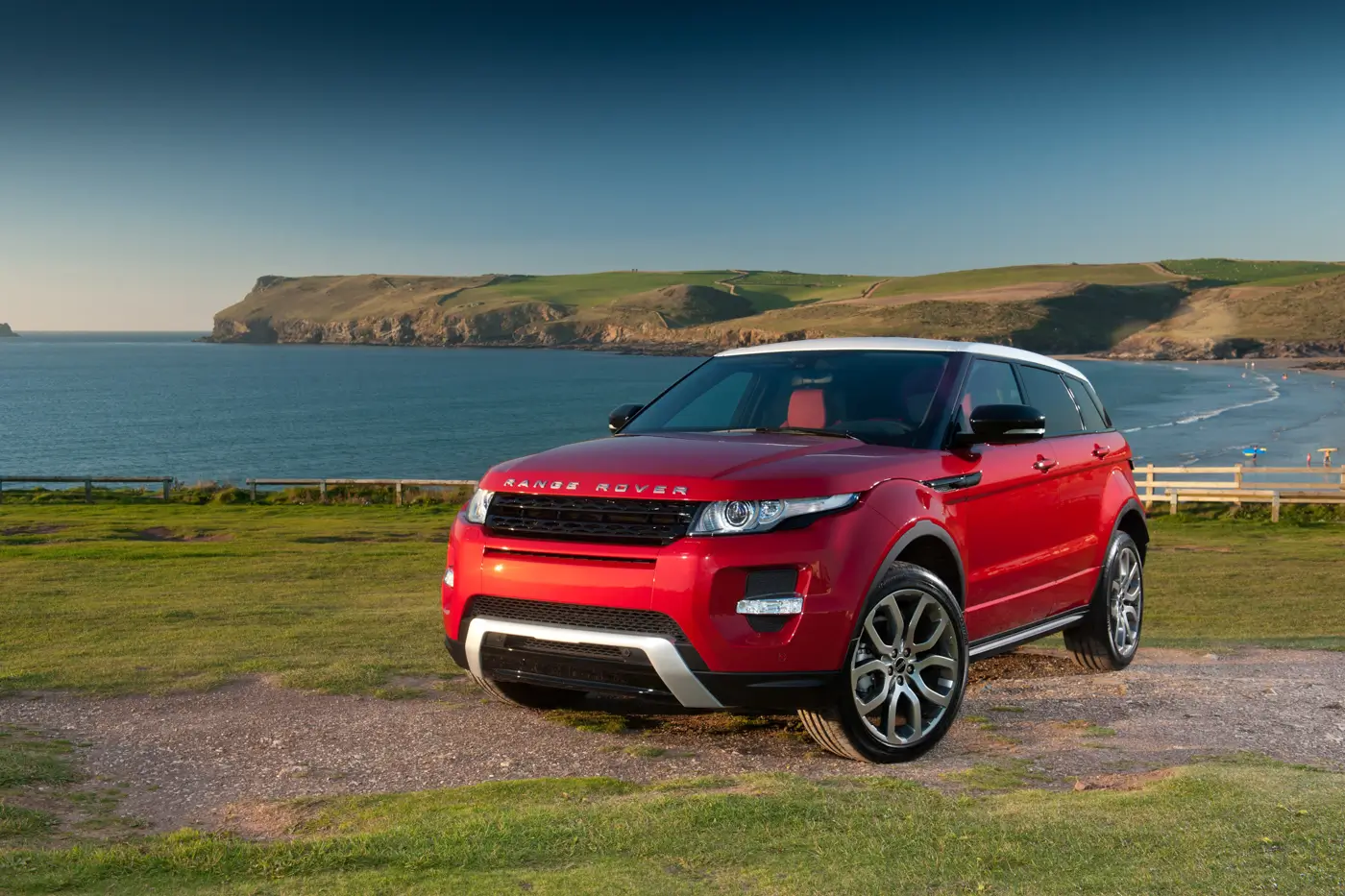
We take the premium small SUV market for granted now, but it didn’t really exist back then.
It was a white space – nothing else existed. I did a lot of research and we knew the relationship between BMW’s X3 and 3 Series, Audi’s Q5 and A4, therefore we could pretty much guess where X1 and Q3 would come out at price-wise, even though they didn’t exist – but 1 Series and A3 did exist. We were actually pretty close. I was quite chuffed with that. The Germans are sometimes quite predictable.
What didn’t go smoothly during the Evoque launch?
Having been the pricing manager, I got it all signed off. I then moved to be the Financial Controller of the Halewood plant. At that time it built Freelander 2 and the Jaguar X-Type – and it was the plant where Evoque was going to be built because it was on the same platform. That ultimately resulted in the X-Type ending production sooner than planned, along with its slow sales and the other problems it had. That car came out, Evoque came in, and that’s where I had an annoying situation where a decision I made came back to bite me in the bottom.
We had a predicted volume, and we had to guess some more when facilitating the factory. One of the really important things is the paint shop. Evoque came out with a contrast roof option, and I was part of the team that guessed the take-up at being 10 per cent. Therefore, we had it so the whole car was painted in the body colour, then masked and sent back into the queue to have its roof done. That’s fine for 10 per cent, but when early orders came in at 65 per cent it was an inconvenience. We couldn’t keep up after a few months.
The paint shop was a loop. What we ended up doing was putting in a separate sort of trunk road where cars with the contrast roof would go to be painted. We didn’t do it initially because of the cost and we didn’t think we needed it, but when we did need it, it taught me that every decision has a consequence. When you’re trying to plan volume, you have two choices and sometimes it’s better to err on the side of optimism.
You moved from JLR to Bentley. What was the first big difference you noticed between the two manufacturers?
I initially went to look after production which was a real eye-opener of how to build low-volume cars. Because at JLR, we were very rightly very proud of Range Rover particularly, and all the different colours you get in the interiors and how great a car it was. But even if you order a really fancy ticket, it’s still coming on a truck from the seat supplier.
At Bentley, every interior – even on a black and black car – is handmade at the factory by these skilled craftsmen and women. That’s the difference you expect, isn’t it? Every veneer just comes in as planed wood and it all gets done on site by hand. Being in charge of the manufacturing team was really interesting because it was completely different – the time, how the car was assembled, and Volkswagen’s focus on quality and engineering was immense.
What path through Bentley led you to becoming head of Mulliner?
After manufacturing I got the job I was trying to avoid: marketing finance. I loved it! But after six weeks there was a change in leadership and I was required as Head of Financial Planning. That turned out to be the most important job of my career, as I was in the inner circle of the Bentley Board who met every week, without being on the board itself.
The brand went into a period of problems – we’d just launched Bentayga, maybe visually not perfect initially, but a fabulous car. The plan was for it to add volume to the brand. It sold, but the other cars dropped. Then dieselgate hit us, meaning everything had to be re-certified. There was only so much certification capacity in the group, and we kept getting kicked down the list. We had six to nine months with no cars to sell. It was an absolute killer – especially in America. Volkswagen’s reaction was to sack the entire Bentley board other than the CFO – my boss.
That’s when Adrian Hallmark came in as the new CEO, and the new Bentley board spent six months trying to work out what strategy we should take because what we’ve done hasn’t worked. Why is Ferrari so profitable, Lamborghini a bit profitable, and Aston Martin, McLaren, Bentley not profitable? It was a big piece of work I had to drive because I was the finance guy.
The answer is very simple: they make more money because they sell their cars at a higher price. Ta da!
But how? We looked at it and their material cost is broadly the same as that of a Bentley. Their R&D costs are a little lower because of their 15-year platform cycle with a new model name and top hat every five years. Everything you touch or the customer sits on you change, everything else you leave, so they were a bit more efficient. And they sell a lot of hats. But putting that to the side, they’re still more profitable because their revenue is higher, and why’s that? Because they sell a low volume of mega-expensive cars for £2–3million.
That’s not actually what drives the revenue, what does is the standard Ferraris that can be sold for £500,000 because that seems cheap compared to £3,000,000. You buy a £400,000 car, spend £100,000 on options and it still seems like you’ve got a deal.
Whereas at Bentley, all we had was the Continental GT Speed at £200,000. If you spent half the amount on options as on an equivalent Ferrari, you bought the most expensive Bentley ever, and you were probably going to lose money. So how do we fix that? We remembered that we own a brand called Mulliner which we’d not really used or understood properly.
Adrian Hallmark said it was going to change the world, and chose it to launch coachbuilding, sell a £1.5m Bentley, do continuation models like the Blower and Speed 6 which would show parts of the world who don’t know about the brand what it was doing 100 years ago and that the skill is still there. Then there’s collections, applying Mulliner-ness to normal Bentleys which gives customers permission to spend £100,000 on coolness and customising their car, and how to make it bespoke.
Therefore, they’re happy to spend that much on options because it’s not a £1.5m Bacalar. It’s not scary. That’s the strategy we came out with, then I went to run Mulliner to deploy it. It was the best job in the world.


It’s no coincidence that soon after Mulliner came to the fore, we started seeing Q, Sonderwunsch, MANUFAKTUR, Ad Personam…
Everyone realised that’s how you make money: by giving customers experiences and stories. So you sit in a room, a customer could just go and buy a stock Bentley, or they could come and sit in a room with a proper Mulliner designer, who can use a computer to configure the car only the customer can imagine, and show them all the materials.
Then they walk into the factory and the designer says, ‘You know what? When you have your bespoke interior, we don’t build it in the main factory, we make sure your special leathers go to Betty, Peter and Paul who are the best seat makers in the world. You want custom stitching? Let me introduce you to James…’ That’s the value.
The Mulliner customisation ethos has clearly come with you to RML. If we bring it back to GT Hypercar, something I always find interesting about projects like these is they allow the customer the ability to re-spec their car as if it was new. But how many of the 39 build slots are to a ‘standard’ specification?
There’s one red GT Hypercar which is the closest to standard we’ve got because he liked the standard spec. It wasn’t because he couldn’t afford to have whatever he liked. No, he has a massive car collection, but he likes the purity. He’s buying one of the first ten – the 40th Anniversary Editions – and only one of those can have the red.
He’s optioned up to the lower part, all the visible carbon rather than black, so it’s not standard, but it’s only optioned up a small amount. He did want the Recaro seats with the colour of the donor car’s seats, but he didn’t want anything else done to the interior because he already loves it.
What is important to a customer is their spec because that’s what makes it their car as opposed to a car.
Is it job done on GT Hypercar, or will you continue refining it as production continues?
I think the core of the vehicle is set, yes. But there may be some nuance that we discover and decide to update; I’d expect any final tweaks to be resolved within the next six months once we’re into the teens of production.
Because again, it’s a bespoke car, you spend a lot of money on it. We’ve gotta look after our customers. As with my other experience, once you’ve got a customer, he or she’s the easiest person to sell your next car to, because they’re part of the family. If you treat them well and you look after them and if they cast some issues, you fix them.
How far ahead is the product calendar? What’s next for RML – and is Project 40 on your radar already?
What’s next won’t be called P40 because that’s been and gone, but our focus at the moment is P39 – GT Hypercar. We’ve got 39 of them to build. You’ve seen up to Car 9 here, Car 10 is off-site. What’s important is that we see this programme through. And as much as people are wanting to jump onto the next one, I said, no, no. We’ve done the fun engineering stuff. We’re now into production. The next step is to get the build on this efficient, to learn, to feed back into engineering. If we can’t get any more efficient on one bit because you’ve engineered one way, next time we need to engineer it another way.
Because what’s next only takes me nine months, if I started that now, I’ll have got it ready before I finish building the GT Hypercars. And what I don’t want is to distract customers with the next thing when I want them to be focused on GT Hypercar.
I need to manage my workflow to keep the team growing in their capabilities and learning. So I don’t need to do my next car yet. Now, what we do next is a good finance strategy conversation because we’ve done a very good job modifying a Porsche. So should we start to specialise in modifying Porsches?
GT Hypercar is four-wheel drive with PDK. Do you want to go and do a two-wheel drive manual? For example, a lot of people ask if they can have it without the rear wing because it’d look cool. It would, but you’d go into a hedge backwards very quickly because it’s a fully balanced car as it is, so if the rear wing went I’d have to change the front end.

What if I came to you with a 911 S/T and asked if it could look very similar to the GT Hypercar?
I’ll happily do a one-off, but the cost will be higher. Or maybe that’s something I’ll look at in the future as a part of a production run. So it comes back to what does the customer want? If he or she just wants a one-off car based on their donor car, I will do that for you, but it’ll cost more than the price of one of these because you’re paying me to engineer it.
You’ve currently got projects going on with piston, hybrid, electric and hydrogen powertrains. Do you see the industry remaining multi-fuel for the next few years?
It’s an interesting philosophy because if you backtrack to, say, 2021, the automotive industry thought the world was going fully electric. Governments were saying by 2030 or 2035 there’d be no more combustion cars. So the manufacturers had to follow that and all their cycle plans switched. So Bentley stopped selling W12 engines. Porsche was about to launch an electric Cayman and Boxster. Rolls-Royce launched the Spectre. Bentley didn’t have a replacement for Bentayga because it was only going to be the electric car that came out this year.
Everyone jumped that way and then over the last few years, as Lotus – where I was Chief Financial Officer for two years – launched all these electric cars, and the world didn’t go down that path. We’ve all discovered, the world isn’t quite going as we were expecting. For the next little while, I see a mixed-fuel scenario that says different use cases need different powertrains.
And then there’s hydrogen. When Ford bought Land Rover in 2000, they came over to us. We had lots of big conferences where the Ford execs came over to explain to us how the future was. And it was really interesting. And I can remember sitting in the big conference room at the Heritage Motor Centre, because that’s what we used for those big conferences. In 2001 or 2002, and they were explaining that within 10 years, hydrogen was going to be the fuel.
And that was in 2000. And now it’s 2026.
And it’s still the future…
It’s the future, but it ain’t the present. Again, I can see cases where hydrogen makes complete sense. But other cases where it doesn’t. And again, is it hydrogen combustion or is it hydrogen fuel cells?

Back to RML. What if you pulled rank on everyone and put your dream project on the board? What car would you most want to give the RML-treatment to?
No one has ever asked me that.
That surprises me.
To answer the question slightly differently. What project would I like RML to get involved in that it isn’t? I’d love to take the company back to Le Mans in the present ruleset. It’s a really exciting formula that works. That’s a place where the brand could sit well, and it would help demonstrate the capabilities. So I’d love to be able to find a partner who wanted us to take them to Le Mans. That would be really cool.
But as for what cars I’d like to RML-ify? I love old British cars. And part of the problem with old British cars is that they’re old British cars. What would be cool – but I’m not sure it’d be commercially viable – would be to take some of the ’70s and ’80s cars that I like and make them what they could’ve been. A Triumph TR8 would be cool to do – as would a Stag – but you know, nobody has restomodded ’70s/’80s Triumphs for good reason!
Where do you see the business in five years?
Broadly the same as what you see today, just bigger. It won’t be five people upstairs building harnesses, it’ll be 15. I won’t be hiding two White Label cars from you, I’ll have four. We’ve laid the foundations now of pivoting from a business that just did one or two big projects to doing multiple projects, and they all need to grow.

For the apprentices that are coming through now, how is their start in the automotive industry different from yours, and how is it similar?
The world I started in was the old world – everything was mechanical and physical. In my first six months I learned how to use a lathe, milling machine, welders and how to wire things. I did three months in the post room delivering memos on an electric milk float. If you wrote a memo to someone, they wouldn’t get it ’til the next day.
They’re in a digital world where AI is changing everything. But it’s empowering them because you can get data and use it to analyse it for you. It can help solve the problem of why, for example, a driver may be feeling mid-corner traction issues because the car is pitching too much.
Where the apprentice is starting, they’ve got tech as their friend, but they’re still learning how to do physical things. You still use your hands and fingers. You can’t digitally build things. But you can digitally design it, understand it, so you can make your build quicker. And you can use the AI as a tool to help you understand; it gets to that endpoint quicker.
If you could go back to 1997 and tell the teenager starting his apprenticeship at Rover Group that by 2026 he’d make it to the top of the tree, how do you think you’d react?
Young me would not believe that.
What advice would you give yourself?
Pay more attention to the bad leaders and more attention to the great leaders. Adrian Hallmark has been a great inspiration. He inspired the whole of Bentley and he took them on a journey. But when you work directly for him on his 1st line, he was really challenging to work for. He pushed and pushed and at the time you never felt like you did well enough; he always couldʼve done better than me. But then I sit back and on the flip side, I realised that approach pushed me to achieve things I wouldn’t have thought possible, because that style of management is what I needed. So often I now look at a problem and think, ʻWhat would Adrian do about this?ʼ
At JLR I worked for Adrian Mardell. He inspired me because he was my boss when I was in finance, and he went from being a finance guy to being CEO. I worked for some very good Adrians.
I’d also say to myself: when you get where you’re going to get, make sure you remember the journey you’ve been on.
I’m very lucky to have gotten here. Lots of people work as hard as I have, are as passionate, and don’t get the chances to be where I’ve got to today. And I’m only here today. Who knows what tomorrow is going to bring? So I don’t walk around going, ‘How great am I that I succeeded?’ I walk home thinking how lucky I am to be with this opportunity. Let’s make it work.