-01.svg)

The car used for the record run would’ve been more than fast enough in its competition guise. However, after a dieselgate-prompted withdrawal from the FIA World Endurance Championship (WEC), Porsche engineers got to work to give the prototype the send-off it deserved.
From 2014-2017, four iterations of the 919 Hybrid would win 17 of the 34 races entered, scoring three consecutive FIA WEC Teams’ and Drivers’ Championships, and three victories at the 24 Hours of Le Mans. Powering every example was a 90-degree 2.0-litre turbocharged V4 petrol engine driving the rear wheels, along with a front-axle electric motor giving the car temporary all-wheel drive. Similar to F1’s current hybrid engines, the 919’s V4 used an energy recovery device connected to the turbo wastegate. On its own, the engine made just under 500bhp, with the hybrid system bringing an additional 395bhp under acceleration.
Although the LMP1 regulations were fairly free at the time, simply mandating the cars to be a certain size, and to use reciprocating pistons, there were some limitations to how far the aerodynamics could be taken, and a minimum weight to adhere to. However, with no rulebook to play by, and refined components from a 2018-spec car that would never race, the 919 was turned up a notch with more grip, more power, and less weight. The 919 Evo was born.
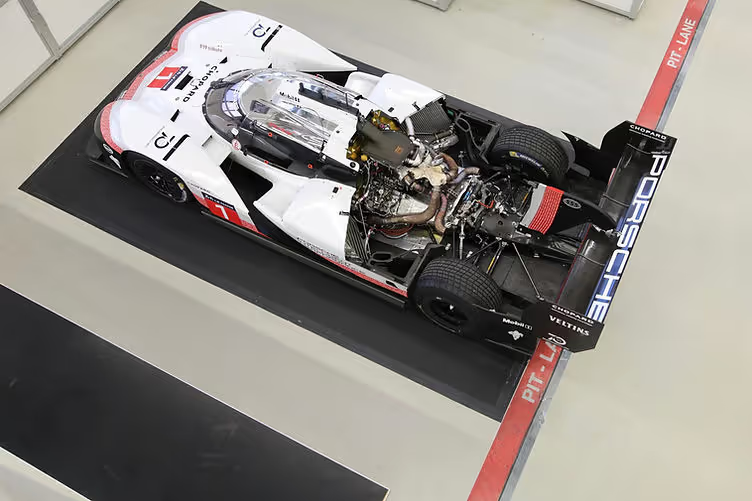
Active aerodynamic elements were introduced, with the most obvious being the enormous rear wing that extended far beyond the car’s bodywork. This was balanced by a new front wing located underneath the redesigned nose section, and both featured drag reduction systems to allow for faster speeds through corners, and along straights.
The pushrod suspension gained strengthened wishbones, active pitch control to further improve stability, and specially developed Michelin tyres which shrouded 18” forged magnesium wheels at each corner. A new brake-by-wire system was installed, and the hydraulic power steering was adapted to cope with increased loads.
With no regulation-mandated fuel flow or electricity usage limits to adhere to, the V4 engine developed 710bhp thanks to an updated ECU, while electrical output increased to 434bhp. The engine continued to send its performance to the rear wheels via a 7-speed sequential transmission, but the combined system output rose to 1,144bhp.
The competition-spec 919 Hybrid was already a light car at 888kg, but its dry weight was dropped by a further 39 kilos owing to the removal of anything non-essential for completing a fast lap. The air conditioning, headlights, tail lights, position lights, inbuilt pneumatic jacks, and even the windscreen wiper were set aside on the Evo.
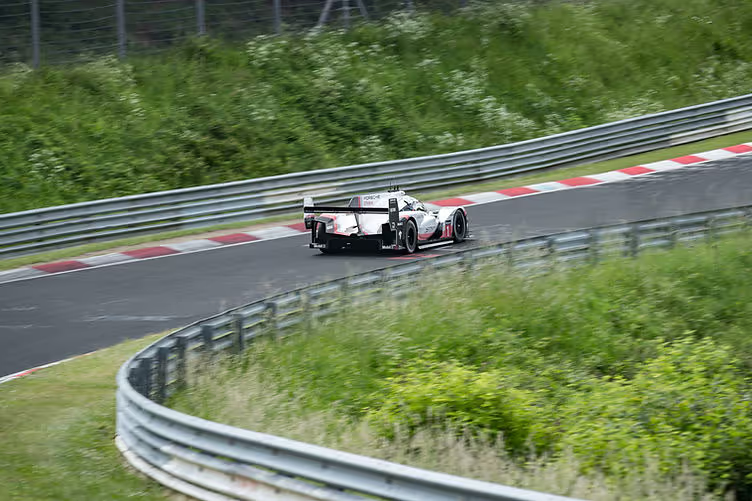
Its first lap record attempt was at Spa Francorchamps, and the 919 Evo hit the ground running. Driven by 2016 WEC champion and Le Mans winner Neel Jani, the car only needed 1:41.77 to traverse the Belgian track. The track record belonged to the Porsche, which was faster than a Formula 1 car - an astonishing feat, no doubt - but when it comes to lap records, one place matters more than any other: the Nürburgring Nordschleife.
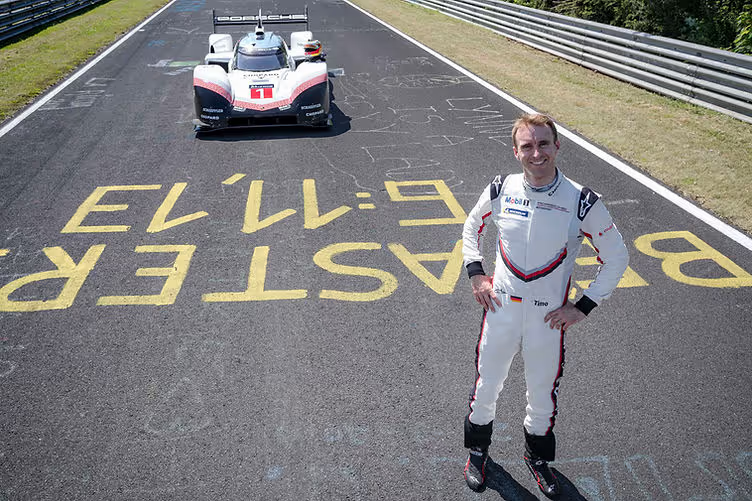
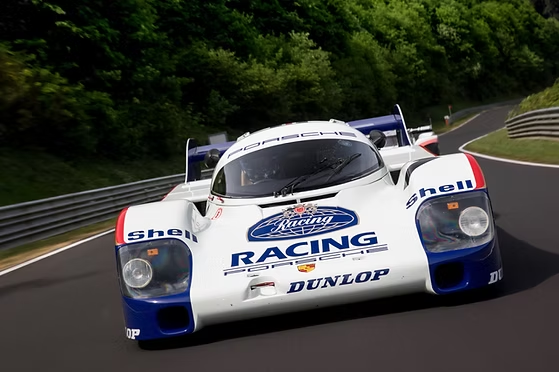
The time to beat was 6:11.13, set 35 years and 11 days prior by Stefan Bellof at the wheel of a Porsche 956 Group C racer during practice at the Nürburgring round of the 1983 World Sportscar Championship. Piloting the 919 Evo was reigning WEC champion, two-time Le Mans winner, and five-time Nürburgring 24 Hours winner Timo Bernhard, ahead of him was a clear track with near-perfect atmospheric conditions, and he made the most of it.
Bernhard’s smooth but decisive driving steered the 919 Evo into the history books. In less than one minute, the car had got from the start/finish line to the heavy braking zone at Aremberg corner, which was duly taken at a minimum speed of 87mph.
Top gear was selected at 186mph, with a burst of hybrid boost propelling the car from 200-216mph in the blink of an eye, while going uphill.
The car looked like it was on rails, with the active aerodynamics, pitch control, and the traction control working overtime to keep the car gripping and advancing at record pace; the only part of the circuit where it scrambled for traction was on the exit of The Carousel - a corner which it took at a minimum of 58mph.
The onboard footage is hypnotic, yet relentless. The 919 Evo returned to the start/finish line after only 5:19.55, where it emphatically claimed the outright lap record by a margin of 51.58 seconds. In the aftermath, Bernhard said: “Thanks to the aerodynamic downforce, at sections I never imagined you can stay on full throttle. I’m pretty familiar with the Nordschleife. But today I got to learn it in a new way.” An admirer of Stefan Bellof - the previous record holder - throughout his career, Bernhard added “Today my respect for his achievement with the technology available back then increased even more.”
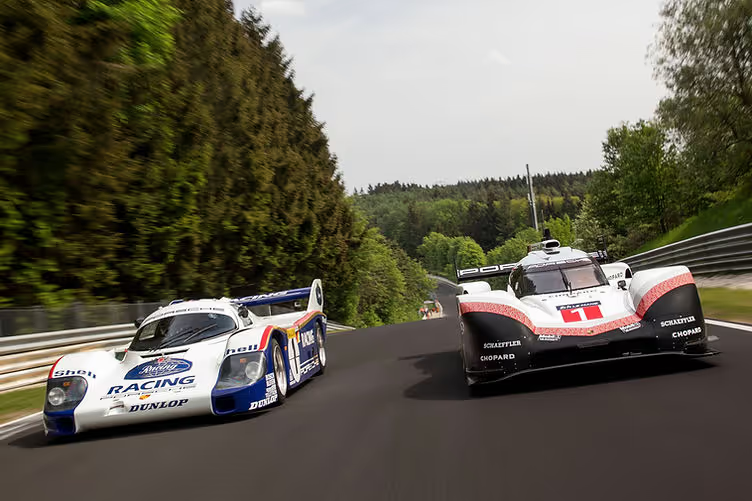
In the six years that followed, lap times and records have fallen in almost every category; the Ford Mustang GTD is the fastest American car at The ‘Ring with a time of 6:57.69. The Mercedes-AMG ONE is the fastest production car - by a huge margin - at 6:29.09, but even that is over one minute adrift of the gauntlet laid down by Porsche.
The previous record stood for over 35 years, and it took an extreme variant of an already rapid racer to topple it, breaking the six-minute barrier in the process. Some have added an asterisk to the 919’s lap time as it wasn’t set during a competitive meeting, but none of the production car yardsticks have been either. Regardless, for as long as its record stands, the 5:19.55 set by the 919 Evo can only be seen as a truly legendary lap.


.avif)

.svg)

