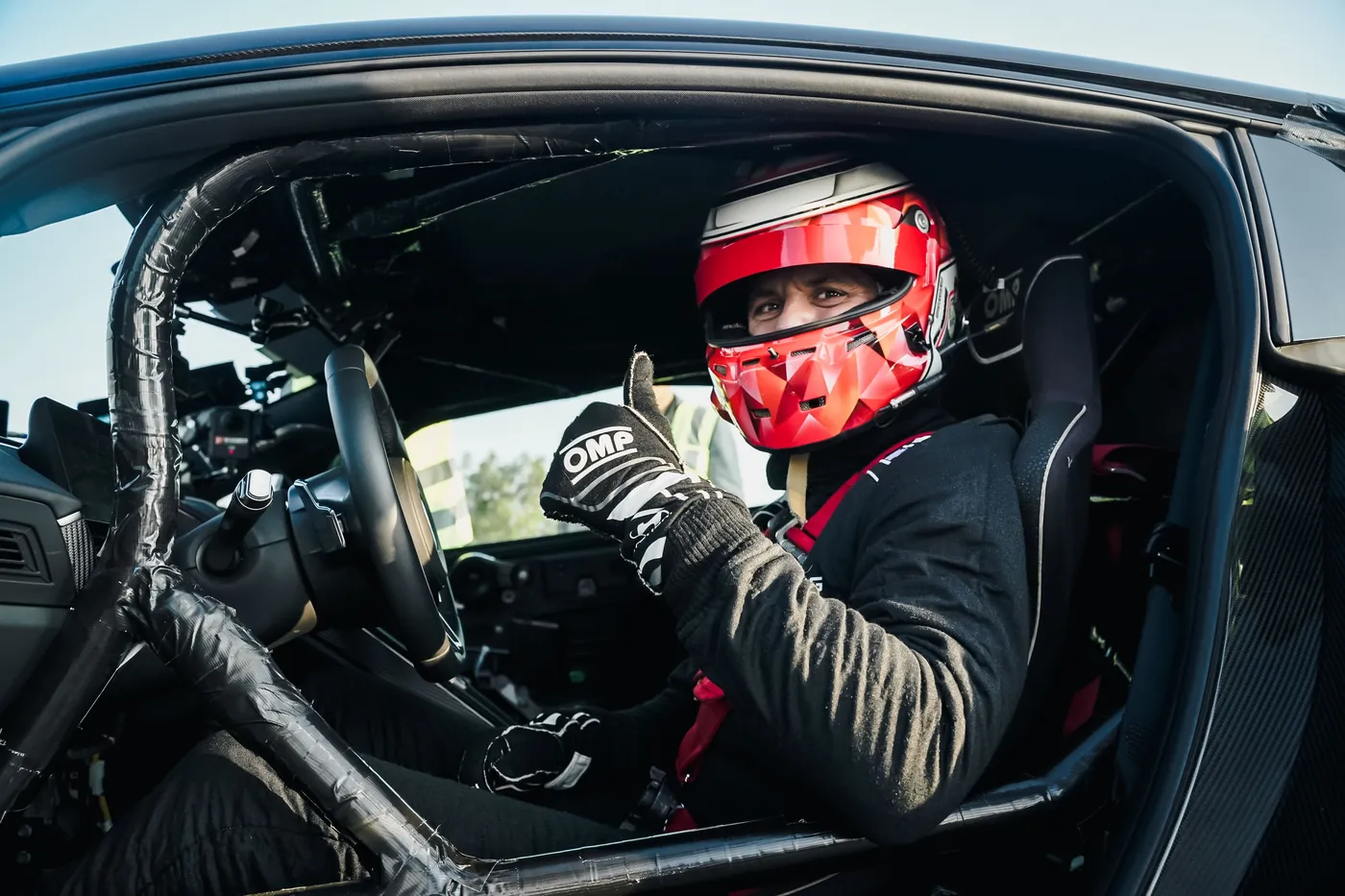
The latest milestone belongs to the Yangwang U9 Xtreme, which has become the first production car to exceed 500km/h. With endurance racer Marc Basseng at the wheel, it reached 503.17km/h (312.65mph) on a closed section of public road in Abu Dhabi on 1 November.
Normally, such endeavours require turning around and recording a run in the opposite direction, with the average accounting for wind and gradient. Yangwang’s figure is a peak speed from a single-direction run, which Guinness World Records has accepted in two specific categories – production cars and electric production cars. The FIA has also recognised the speed. Bugatti’s 490.484km/h (304.773mph) run with the Chiron Super Sport 300+ in 2019 was also a single-direction effort, in a pre-production car.
Basseng also drove the U9 Xtreme to 496.22km/h at Germany’s Papenburg test facility in September last year. Finding the extra speed meant leaving the proving ground for a seven-kilometre straight on the E11 highway, within a 10km section closed for the attempt.
Before any running could begin, the road had to be swept clear of sand and debris, then inspected for stray wire fragments shed by the cleaning brushes themselves – not something you want to discover making its way through a tyre at 300mph.
Two runs on 31 October produced a best of 490km/h, leaving the engineers with work to do overnight. They revised the preparation procedures to get battery and motor temperatures right for the next attempts, reprofiled the damper software to increase rebound damping over undulations in the road and fine-tuned the tyre pressures.
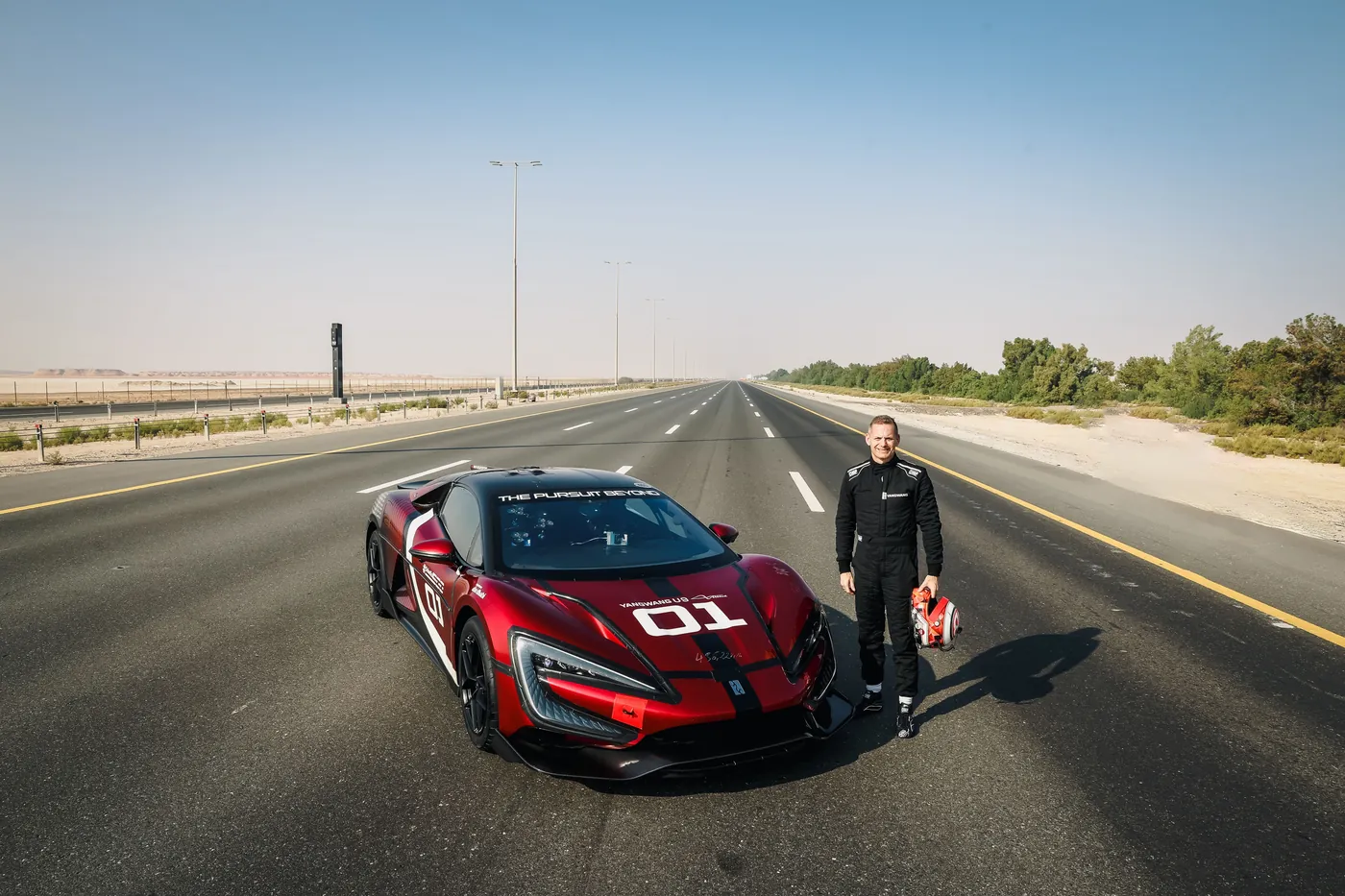
They also increased the rear-wing angle to generate more rear downforce. Even in pursuit of a top-speed record, trimming away drag only gets you so far if the car won’t settle on the road. Basseng returned for two further runs on 1 November, reaching 503.17km/h on the second.
The U9 Xtreme’s four motors produce more than twice the power of the standard U9 and can each spin to 30000rpm. Feeding them requires a 1200V electrical architecture, up from the regular car’s 800V system, and a substantially uprated version of BYD’s Blade Battery.
The battery retains its lithium iron phosphate chemistry, but can release energy at a rate that would theoretically empty a full charge in two minutes. That gives some sense of the demands involved in supplying almost 3000bhp. Temperature management was central to developing the system, as it was to preparing the car between runs.
Giti developed bespoke semi-slick tyres, with a textured surface at the wheel-rim interface to help prevent the tyre slipping around the wheel under hard acceleration or braking. The DiSus-X active suspension adjusts each corner independently and can deliver up to 50kN of force within 120 milliseconds, working alongside torque vectoring that adjusts each wheel’s torque more than 100 times per second.
Yangwang says the record car is the same specification that lapped the Nürburgring Nordschleife in 6min 59.157sec – the production EV benchmark until the Manthey-kitted Porsche Taycan Turbo GT managed 6min 55.83sec earlier this year.
Just 30 examples are planned, and some customers have approved their bespoke specifications and are moving towards contract signing and production scheduling.
‘Breaking a world record once is extraordinary but doing it again in such a different environment is truly special,’ said Basseng. ‘At these extreme speeds every detail matters.’