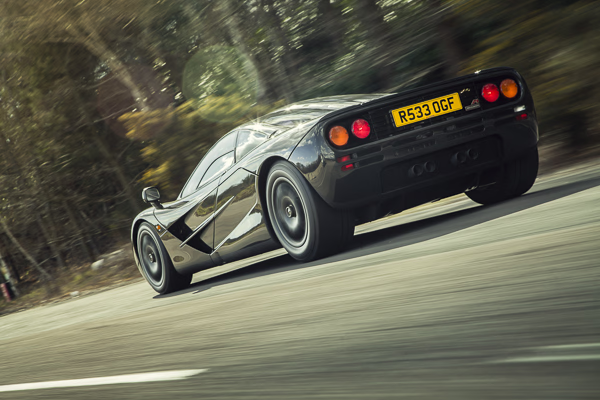
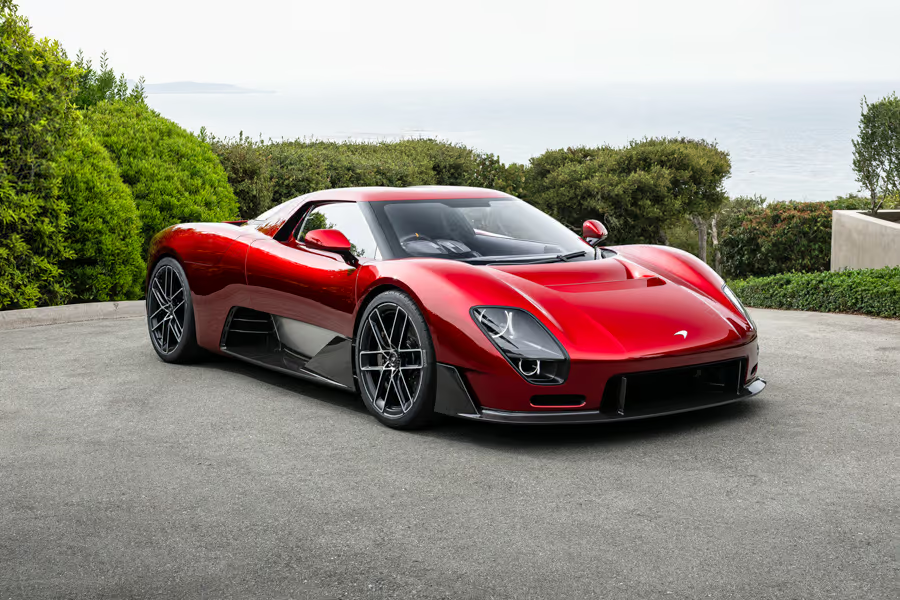
First reported by The Daily Telegraph, the claim was reportedly filed last week and concerns copyright and design rights associated with the original McLaren F1. McLaren has confirmed that proceedings have been initiated.
In a statement to the Telegraph, McLaren described the F1 as one of the most significant achievements in automotive history, and a testament to the vision and engineering standards that continue to define the company. It added that it has a responsibility to protect the integrity of the F1's legacy, particularly for owners, collectors and enthusiasts who value its authenticity.
GMA, meanwhile, maintains that Murray's designs are distinctive and innovative, and has said it is confident of its position and intends to ‘robustly defend the claim’.
The S1's connection to the F1 is hardly coincidental. Murray was the driving force behind McLaren's first road car, which debuted in 1992, and the S1 draws on several of its defining characteristics. Both feature a central driving position flanked by two passenger seats, a naturally aspirated V12 and a manual gearbox. The resemblance extends to the exterior, where the S1's proportions, glazed cabin and detailing recall the F1's body – styled not by Murray, but by Peter Stevens.
In its August announcement, GMA cited the 1992 Monaco show car as the inspiration for the S1's low-mounted auxiliary headlights and lightweight wheels, rather than explicitly naming the production McLaren F1.
The S1 differs from the F1 in key areas, however. Developed by Gordon Murray Special Vehicles, it utilises a bespoke 4.2-litre Cosworth V12 producing up to 681bhp, rather than the F1's 6.1-litre BMW unit. It also adds clutched power steering and the electronic stability systems that a modern road car must have by law – aids that the F1 did without. Shared engineering concepts such as a three-seat layout or a naturally aspirated V12 do not, in themselves, establish infringement.
Murray's association with McLaren stretches back to his Formula One career. He moved from the race team to head McLaren Cars, where he led development of the F1, which subsequently formed the basis of the F1 GTR that won the 1995 Le Mans 24 Hours. He departed McLaren in 2005, later establishing Gordon Murray Design and, ultimately, the automotive business responsible for the T.50, T.33 and more recent Special Vehicles projects.

The S1 was originally announced as a 64-car production run, matching the number of standard McLaren F1 road cars built. In September, Dailysportscar reported that GMA had contacted customers about raising that figure to 75 – the minimum run of road-homologated cars under GT1 proposals being considered by the FIA. GMA's letter reportedly spoke of the S1 competing on the international stage, but the FIA's stated thinking is limited to timed demonstrations or Time-Attack-style events rather than circuit racing. No new category has yet been established.
In 2023, Abu Dhabi investment group CYVN acquired a controlling stake in Gordon Murray Technologies, the engineering division of Murray's business. Two years later, CYVN acquired McLaren Automotive, bringing both operations under the same wider ownership structure. Gordon Murray Automotive, however, was not included in the original sale and remains an independent manufacturer.
The precise scope of McLaren's claim remains unclear, including which elements of the S1's design it believes infringe its intellectual property rights. RUSH has contacted both McLaren and GMA for comment.