-01.svg)
.avif)
Because there’s something about breathing new life into the shapes and sounds of our past, a nostalgia connected to something deeper than just car enthusiasm. Restomods aren’t merely about bringing old cars up to speed; they’re a way of reviving an experience that’s becoming increasingly elusive in today’s world of hypercars and self-driving tech.
Central to this restomod craze is a clear disconnect: wealthy enthusiasts are hungry for connection, personality, and analogue thrill – the very qualities that seem to be slipping away with each new hypercar model. I’m talking about cars so polished, so powerful, and so driven by technology that they’ve become, ironically, rather soul-sapping. Lines of code are now dictating how cars behave, rather than pure, mechanical engineering.
Batteries don’t breathe. Humans do, and so do engines.

Don’t get me wrong, the technical mastery required for the above is an art form in itself. But for many enthusiasts, this disconnect has spurred a longing for when cars were a little less “perfect,” even flawed by today’s standards. Hypercars have become too quick and too distant, and a restomod is the antidote, returning us to planet earth. That’s why, if you asked me to choose between a Ferrari F80 and an RML Short Wheelbase at a show, I’d be poking around the retromod. The same longing for an analogue escape is driving demand for vinyl records, film photography, vintage chronographs and ironically, print magazines.
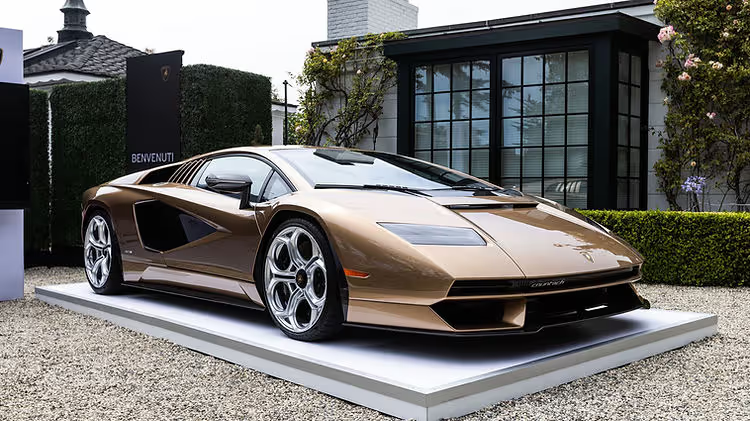
That said, I’ll admit that restomods can be frustrating when legacy manufacturers catch on and start milking the trend for profit. Take the Lamborghini Countach revival or Aston Martin’s recent V-series collectors cars – these do little more than cash in on sentimentality, with manufacturers taking existing underpinnings, slapping on a new body and quadrupling prices. And the less said about ‘continuation’ cars, the better. This isn’t restomodding in its true form; it’s opportunism, plain and simple. These high-ticket, low-value reboots aren’t doing the restomod world any favours, and frankly, they undermine the spirit of what makes genuine restomodding so special.
What I’d love to see more of – and what we’re thankfully beginning to see – is a more accessible approach to restomodding. Brands like Rocketeer, with their V6 Mazda MX-5 conversions, prove that you don’t need a six-figure budget to get into the game. These restomods are built for enthusiasts, not just collectors with deep pockets, and they’re making this trend more approachable for car lovers who want to enhance the experience of driving without having to re-engineer every inch of the car from the ground up. But you might pose the question if a Rocketeer is even a restomod in the first place, or a perfectly executed upgrade.
At the heart of this restomod craze is a clear disconnect...lines of code are now dictating how cars behave, rather than pure, mechanical engineering. Batteries don’t breathe. Humans do, and so do engines.
The world would be a poorer place without Eagle E-Types and Singer 911s. These institutions started as personal visions, ones that only restomodding could fulfil. Many of us had a different “poster car” on our childhood bedroom wall, and restomods bring those dreams back to life, making them practical and exhilarating in a way the originals never could be. The fact that restomodding allows for such variety in execution – whether you’re seeking refined elegance or raw performance – is what makes this trend so exciting and worth supporting. The customisation options are as endless as the pockets of the super-rich are deep.

Finally, if all we truly care about is driving, there has been a restomod in production for over 50 years, right under our noses – ladies and gentlemen I give you the Caterham 7. It’s a classic design that has been continuously updated and improved without losing its essence, and it remains one of the purest driving experiences available. In a world obsessed with constant novelty, the Caterham has stayed true to the original spirit while embracing just enough modernity to keep things authentic.
In the end, whether we agree with every direction the restomod craze takes, we should at least appreciate the pursuit. Restomods bring the past and present together in a way that no other automotive trend does, and they’re keeping modern classic car culture relevant in an increasingly digital, tech-driven world. Or in the case of the electromods, making them sustainable. For that alone, they’re a good thing – at least until we get the inevitable Fiat Multipla restomod. But who knows, maybe even that could surprise us.


.avif)

.avif)

.svg)

