-01.svg)

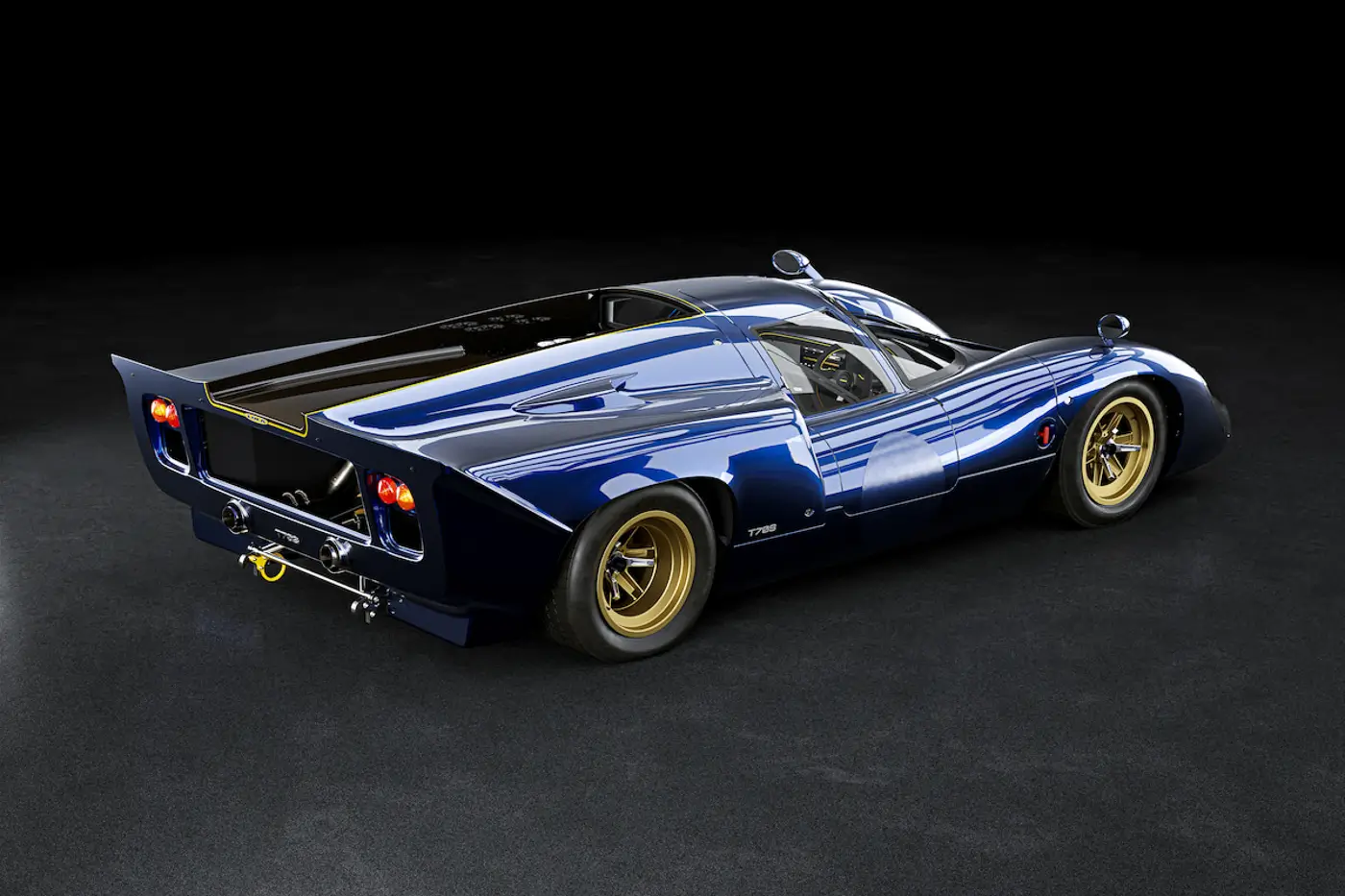
Now, Lola Cars has announced a run of sixteen new cars based on the MkIIIB, offering buyers a choice between a certified racer (T70S) and a road-going variant (T70S GT). Every dimension is faithful to the original. What Lola has modernised is the construction process – and it's far more than a simple pivot to carbon fibre.
In a claimed world first, Lola has developed a composite matrix made from flax and basalt fibres, bound with a PFA resin derived entirely from sugar cane processing waste. According to Lola, it outperforms conventional glass-fibre composites in tensile strength and stiffness, while demonstrating better impact damage tolerance than carbon-fibre/epoxy. Dubbed the Lola Natural Composite System, or LNCS, no petrochemicals are used at any stage of its manufacture.
.jpeg)
Two versions of the small block Chevrolet V8 provide the firepower. In the T70S, this means a 5.0-litre unit producing 530bhp and 425lb-ft of torque, complete with exposed individual throttle bodies and a 7,300rpm redline. It's mated to the same period-correct Hewland LG600 five-speed transaxle that helped the MkIIIB claim victory in the 1969 Daytona 24 Hours. Each car will be supplied with an FIA Historic Technical Passport: the brakes, suspension, aluminium monocoque and powertrain all remain true to the original heritage specification. This means double-wishbones all-round, coilover dampers, 15-inch magnesium wheels and four-piston calipers on 304mm discs at each corner.
Where Lola has quietly intervened is safety: seat belt mountings and roll cage strength have been improved, executed in a way that remains historically compliant. Weighing 860kg dry, the resulting 616bhp per tonne is good for 0–62mph in 2.5 seconds, 0–124mph in 8.9, and a top speed of 203mph.
.jpeg)
.jpeg)
The T70S GT opts for a larger 6.2-litre version of the engine that sacrifices peak output for greater mid-range. It keeps the ITBs but lowers the redline to 6,600rpm, developing 500bhp and 455lb-ft in the process. The gearbox differs too, switching to a Lola-specification six-speed Hewland better suited to road use. The cabin also makes further concessions, adding climate control, improved ergonomics and limited storage.
The larger powertrain, loss of the magnesium wheels and relative luxury mean the GT weighs an additional 30kg, stretching the 0–62mph sprint to 2.9 seconds. Once moving, however, it pulls just as hard as the racer, with 60–100mph taking an identical 6.4 seconds, and it is still capable of 200mph. Lola stresses any modifications have been executed with restraint, ensuring the T70S GT will still offer an “unapologetically visceral driving experience.”

Lola clearly isn't positioning the T70S as a green car. But it is mindful of its carbon footprint, commissioning an independent Life Cycle Assessment to quantify the impact of LNCS. Its findings show that bodywork production alone cuts CO₂ emissions from 2,533kg to 926kg CO₂e against conventional GRP manufacturing – a reduction of 63 per cent.
Given the need to secure an FIA Historic Technical Passport, any further gains could only come from how the remaining materials were sourced and processed. To that end, Lola has targeted magnesium: in a car weighing 860kg dry, the alloy accounts for 104kg – not just in the wheels, but in the front and rear uprights and structural crossbeams too – and few automotive materials carry a heavier manufacturing burden.
.jpeg)
For the T70S, all magnesium components are extracted from Dead Sea seawater via solar-powered electrolysis, then cast in Europe using a proprietary shielding gas that eliminates sulphur hexafluoride. The result, Lola says, is an 80 per cent reduction in CO₂ against conventionally mined and cast equivalents – although, with SF₆ already banned in European foundries, that figure should be taken with a pinch of sea salt.
With events like the Goodwood Revival already mandating sustainable fuels, the LNCS adds another credible defence for a form of motorsport coming under increasing environmental scrutiny. Development of the T70S and T70S GT will continue throughout 2026 with Grand Prix winner Johnny Herbert as the official test driver, though pricing and production timelines remain unconfirmed.
The T70 has been enduring since 1965. On this evidence, Lola intends to keep it that way.
.avif)




.svg)

