-01.svg)

The Ace was known for its racing career, winning in the 2-litre GT class at the 1959 24 Hours of Le Mans. It also saw success at the 12 Hours of Sebring, where a privately owned Ace won its class three years in a row. Despite its achievements, the Ace is overshadowed by the model that followed – the AC Cobra.

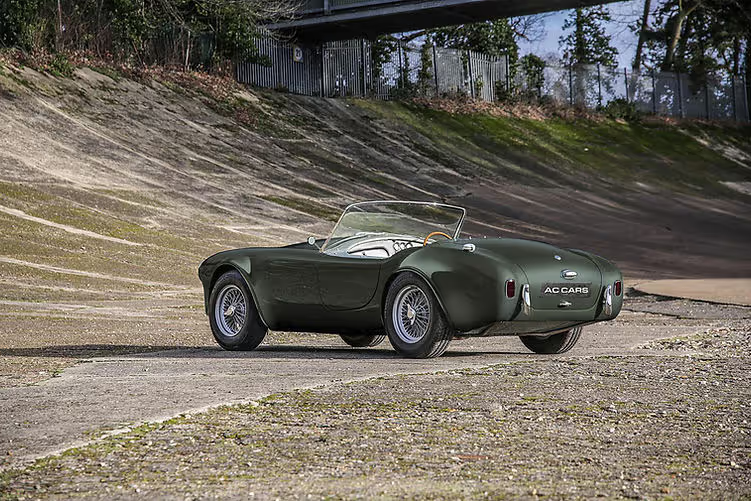
In 61 years, the Ace has only gained 111kg, bringing its weight to 1,100kg – a featherweight in today’s world. While they are styled to look like the original, they are built from the ground up as entirely new cars, using modern production techniques, a tubular steel chassis and a carbon fibre body. The two variants differ slightly in style, with the Ace Bristol having a larger grille. The original Ace used a 2.0-litre inline six-cylinder from Ford, while the Ace Bristol was fitted with a similarly sized straight-six from Bristol Cars – hence the name.
Unlike the Aces of yesteryear, both the Ace and Ace Bristol will use the same powerplant – a 2.3-litre Ford EcoBoost engine, as found in the Focus ST. Power has increased to approximately 320bhp, with 277lb-ft (375Nm) of torque heading to the rear wheels through a manual gearbox. With a 0–62mph time of 4.6 seconds and a power-to-weight ratio of at least 290bhp per tonne, the new Ace looks set to make good use of its performance and low kerb weight.
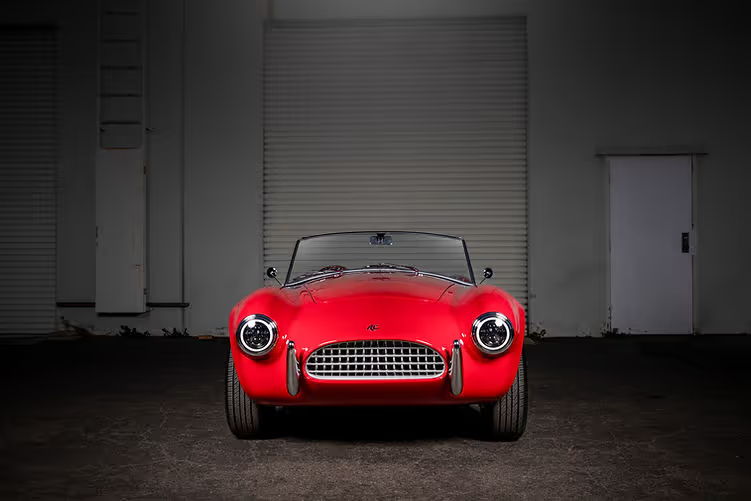
AC has also launched an electric Ace, for those who fancy the idea of an electric classic without having to rip out a classic’s internal combustion heart. Tremec’s modular EV platform is integrated into the Ace to provide impressive power, range and weight figures. It produces 300bhp and 369lb-ft (500Nm) of torque, and tips the scales at less than 1,134kg. The 72kWh battery provides a range of over 200 miles. Like the petrol-powered Ace and Ace Bristol, the electric version will have a carbon fibre body wrapped over its chassis, helping to achieve such a low weight.
Ensuring that the new Aces remain true to their ancestors, each new Ace that is built will receive an AC chassis number – showing its relationship to its older siblings. Order books are now open, with deliveries starting in summer 2025 and prices starting from £175,000 for the petrol-powered Ace and £213,000 for the electric versions.


.avif)

.svg)

