NEWS
2026 BMW M Hybrid V8 Sets Sights on Victory Lane
Ken Pearson
By
Images by
IMSA
Published
18 Jan 2026
2026 BMW M Hybrid V8 Sets Sights on Victory Lane

Aerodynamic balance and cooling efficiency have been improved as BMW Team WRT targets consistent performance in 2026.
Following a challenging 2025 campaign, BMW has overhauled its LMDh-spec M Hybrid V8 racer ahead of IMSA GTP and WEC Hypercar competition this year. The most notable changes are found at the front, with a restyled kidney grille flanked by new headlights. It would still look at home in a BMW showroom, but the tweaks aren’t just to make the carbon fibre coupé look like a closer relation to the M5 than the Z4.
Top-level prototypes are allowed a limited number of development or “evo” jokers throughout their five-year homologation periods. BMW have chosen to use some to remove the diveplanes, and add a new upturned splitter. This will help recover some of the downforce lost from canning the canards, while minimising drag at the front end. A turning vane beneath the sidepod has also been reduced in size.


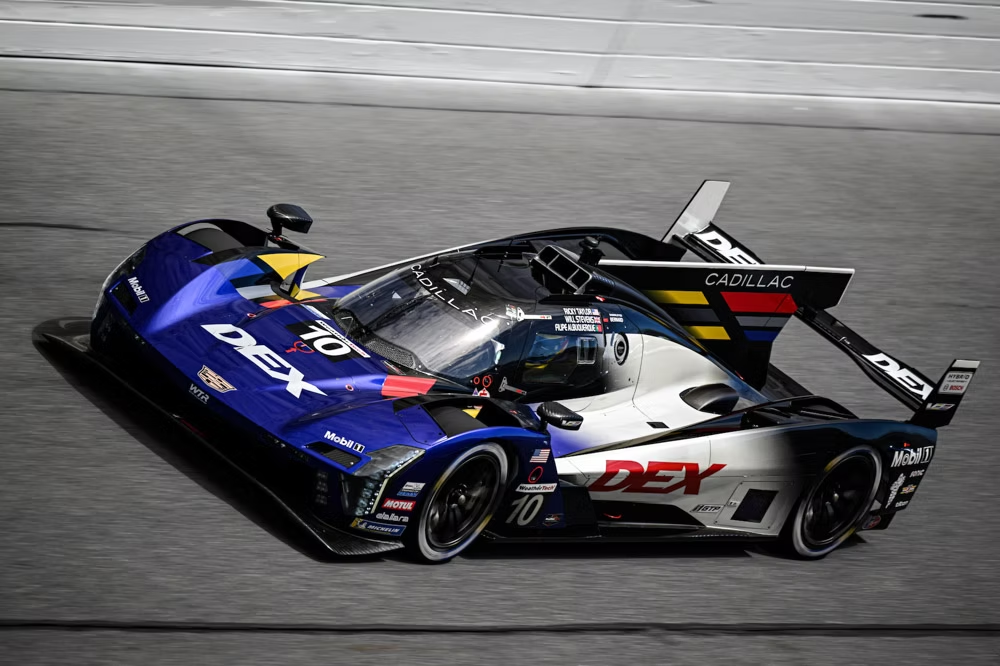
What can’t be seen is the extensive reworking of panels, vanes, and ducts underneath the M Hybrid V8’s carbon fibre skin. Cooling efficiency has been improved and the car should offer more consistent performance across the range of tracks it’ll take on. BMW are clearly happy with the aerodynamic performance at the rear of the car, with the wing being unchanged for 2026 - unlike the reworked challengers from Cadillac and Toyota who’ve introduced dual-profile aerofoils.
Alongside the double-Y LED lighting and M1-style dual BMW badges, the M Hybrid V8 carries over its powertrain with no modifications. As hinted by the name, the car uses a 4.0-litre twin-turbocharged V8 engine paired to a hybrid system. Like the other contenders built to LMDh/GTP rulesets, the electric motor is a specified unit supplied by Bosch. Total system output stands at 671bhp.


Despite recording four consecutive pole positions at the start of last year’s IMSA season, and challenging for the overall win at the Daytona 24 Hours until the final stint, the M Hybrid V8 only scored one outright victory. In the WEC, the car remains winless. For the upcoming season, Team WRT has taken over the operation of both championship campaigns, replacing long-time partners Team RLL in the USA.
A pair of cars will be entered in both championships, with the updated prototype making its competitive debut at the IMSA season-opening Rolex 24 at Daytona. The WEC season begins in Qatar in March, but the focus will already be on bettering last year’s 16th and 17th place finishes at Le Mans. The BMW M Hybrid V8 has shown plenty of potential since its first race in 2023, but it’s high time it became a consistent challenger for the top step of the podium.

Author
Photography by:
IMSA
Published on:
18 January 2026
Our Print Magazine
LATEST ARTICLES
About the Author

Ken Pearson
Deputy Editor
Resident Mercedes expert, affordable drivers' car champion and EV sympathiser. Can often be found on the other end of an argument with Craig with regards to powertrains and styling, bringing balance to the force.
Related Articles
NEVER MISS AN ARTICLE

Aerodynamic balance and cooling efficiency have been improved as BMW Team WRT targets consistent performance in 2026.
IMSA
18 January 2026
Aerodynamic balance and cooling efficiency have been improved as BMW Team WRT targets consistent performance in 2026.
First published
18 January 2026
Last updated
18 January 2026
Photography
IMSA
W
Following a challenging 2025 campaign, BMW has overhauled its LMDh-spec M Hybrid V8 racer ahead of IMSA GTP and WEC Hypercar competition this year. The most notable changes are found at the front, with a restyled kidney grille flanked by new headlights. It would still look at home in a BMW showroom, but the tweaks aren’t just to make the carbon fibre coupé look like a closer relation to the M5 than the Z4.
Top-level prototypes are allowed a limited number of development or “evo” jokers throughout their five-year homologation periods. BMW have chosen to use some to remove the diveplanes, and add a new upturned splitter. This will help recover some of the downforce lost from canning the canards, while minimising drag at the front end. A turning vane beneath the sidepod has also been reduced in size.


What can’t be seen is the extensive reworking of panels, vanes, and ducts underneath the M Hybrid V8’s carbon fibre skin. Cooling efficiency has been improved and the car should offer more consistent performance across the range of tracks it’ll take on. BMW are clearly happy with the aerodynamic performance at the rear of the car, with the wing being unchanged for 2026 - unlike the reworked challengers from Cadillac and Toyota who’ve introduced dual-profile aerofoils.
Alongside the double-Y LED lighting and M1-style dual BMW badges, the M Hybrid V8 carries over its powertrain with no modifications. As hinted by the name, the car uses a 4.0-litre twin-turbocharged V8 engine paired to a hybrid system. Like the other contenders built to LMDh/GTP rulesets, the electric motor is a specified unit supplied by Bosch. Total system output stands at 671bhp.


Despite recording four consecutive pole positions at the start of last year’s IMSA season, and challenging for the overall win at the Daytona 24 Hours until the final stint, the M Hybrid V8 only scored one outright victory. In the WEC, the car remains winless. For the upcoming season, Team WRT has taken over the operation of both championship campaigns, replacing long-time partners Team RLL in the USA.
A pair of cars will be entered in both championships, with the updated prototype making its competitive debut at the IMSA season-opening Rolex 24 at Daytona. The WEC season begins in Qatar in March, but the focus will already be on bettering last year’s 16th and 17th place finishes at Le Mans. The BMW M Hybrid V8 has shown plenty of potential since its first race in 2023, but it’s high time it became a consistent challenger for the top step of the podium.


Aerodynamic balance and cooling efficiency have been improved as BMW Team WRT targets consistent performance in 2026.