-01.svg)

The technology has genuine motorsport breeding, and while the reality is far more complex, think of it as double VANOS for the combustion chamber – a second ignition system the engine calls upon as demand increases. In a conventional petrol engine, a single spark plug ignites the air-fuel mixture, with the flame front spreading outward from there. BMW M Ignite adds a small pre-chamber machined into the cylinder head above the piston crown, connected to the main combustion chamber via a series of overflow openings. This pre-chamber carries its own spark plug and ignition coil, meaning the revised S58 runs two ignition systems.
Under low and medium revs, the conventional spark plug fires first, with the pre-chamber playing a supporting role largely related to emissions. Under higher revs and loads, the pre-chamber takes the lead. A portion of the compressed fuel-air mixture is channelled through those openings into the pre-chamber, where it ignites separately. The resulting jets then fire back into the main chamber, lighting the mixture above the piston at multiple points.
.avif)

The upshot is a faster, more even burn that helps counter knock and lower exhaust gas temperatures. That in turn has allowed BMW to raise the compression ratio and introduce variable turbine geometry turbochargers, maintaining power outputs in the face of significantly tighter emissions legislation.
In the past, engineers could resort to throwing additional fuelling at the problem under sustained high load, but the Lambda 1 requirements embedded within Euro 7 make that impossible – which is precisely what BMW M CEO Frank van Meel was alluding to when he told Autocar last year: 'Normally, if you are in high-performance situations, you cool using the fuel. With Euro 7, that's impossible – so you need to find different ways of avoiding temperature build-up.'
While BMW M Ignite keeps the fire alive, pre-chamber combustion is not pioneering technology, with Maserati's Nettuno V6 having employed turbulent jet ignition in the MC20 since 2020. Across the Atlantic, Jeep has recently introduced a similar system in its Hurricane 4 Turbo engine – a 2.0-litre four rated at 324bhp.


BMW hasn't confirmed whether M Ignite will trickle down to the B58, the turbocharged straight-six powering the M340i, M440i and M240i that also forms the basis of the S58. With lower outputs to begin with, BMW's engineers have already assured Euro 7 compliance, even though a more powerful variant is on the horizon, likely bringing a badge upgrade to M350i and its ilk with it.
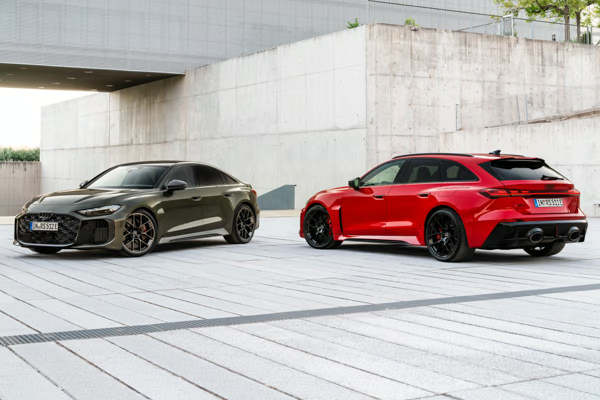
Either way, BMW is clearly working hard to secure a future for internal combustion while the electric Neue Klasse M3 attracts most of the headlines. It will also have been paying attention to what happened when Mercedes-AMG halved the cylinder count in the C63 – a decision that continues to reverberate, with a six-cylinder C53 now confirmed as part of Affalterbach’s course correction. Keeping the S58 alive and Euro 7 compliant will help M maintain its competitive advantage, especially as next-generation rivals such as the hybrid Audi RS5 come to market.
Sadly, the technology won't make it as far as the Alpina B3 GT, production of which has now concluded ahead of Alpina's new era under direct BMW ownership. That chapter begins properly this Friday at Villa d'Este, where the Vision BMW Alpina concept is set to preview the brand's future as an official BMW Group sub-brand.


.avif)

.svg)

